
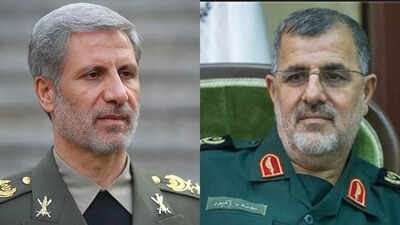
The Middle East edged closer to a full-scale regional war on Saturday after Israeli strikes reportedly killed Iran’s Defence Minister, Amir Nasirzadeh, and senior Islamic Revolutionary Guard Corps (IRGC) commander Mohammed Pakpour, triggering swift retaliation from Tehran and widespread global disruption.
Sources familiar with regional military operations said the two top Iranian officials were believed to have died in the coordinated attacks. Iranian authorities had yet to formally confirm their status as of press time.
The strikes were part of a broader joint offensive by Israel and the United States targeting Iranian military assets, including missile and command infrastructure. Explosions were reported in multiple cities across Iran, including the capital, Tehran, as the operation unfolded.
Iran Launches ‘Truthful Promise 4’
In response, Iran announced a major retaliatory campaign dubbed “Truthful Promise 4,” targeting US military bases across the Middle East.
Missile strikes and explosions were reported in Abu Dhabi, Manama, Doha, Kuwait and Riyadh, underscoring the widening scope of the confrontation. In Bahrain, authorities confirmed that a missile targeted the headquarters of the US Navy’s Fifth Fleet in Juffair.
The retaliation marked a dramatic escalation, expanding the conflict beyond Iran and Israel to encompass US military assets and key Gulf states.
US President Donald Trump defended the operation, saying Washington’s objective was to eliminate imminent threats linked to Iran’s missile capabilities. Israeli officials described the assault as a “pre-emptive” or “preventive” strike aimed at neutralising strategic risks.
Dubai Airports Shut Down
The rapidly intensifying conflict spilled into global aviation, forcing the unprecedented shutdown of Dubai’s two major airports- Dubai International (DXB) and Al Maktoum International (DWC) – after Iranian ballistic missiles crossed regional airspace.
Dubai International, the world’s busiest international passenger hub, suspended all operations on February 28. More than 280 flights were cancelled and at least 250 delayed, according to airport authorities.
Major carriers including Emirates and Etihad grounded services, while Qatar Airways halted flights following the closure of Qatari airspace. International airlines such as Lufthansa, Air France, British Airways and others either cancelled routes or rerouted aircraft to avoid the conflict zone.
The closure disrupted a critical global transit hub linking Asia, Europe, Africa and the Middle East. Aviation analysts warned that prolonged airspace restrictions would significantly increase operational costs as airlines burn more fuel on longer diversion routes.
Oil Prices Climb on Supply Fears
Energy markets reacted swiftly to the unfolding crisis. Brent crude settled at $72.87 per barrel on Friday after touching a high of $73.5 – the strongest level since late July 2025. US West Texas Intermediate (WTI) closed at $67.02 per barrel.
The surge followed stalled nuclear talks between Washington and Tehran in Geneva. President Trump had expressed dissatisfaction with negotiations, reiterating that “sometimes you have to use force.”
Analysts cautioned that further escalation -particularly any disruption to the Strait of Hormuz, a critical artery for roughly 21 million barrels of oil per day – could push prices significantly higher.
Sources indicated that the Organization of the Petroleum Exporting Countries and its allies may review output levels at their March 1 meeting, potentially approving a modest production increase of 137,000 barrels per day after previously pausing hikes.
The price spike presents mixed consequences globally: heightened inflation risks for importers but potential revenue gains for oil producers such as Nigeria, where current prices exceed the 2026 budget benchmark of $64.85 per barrel.