
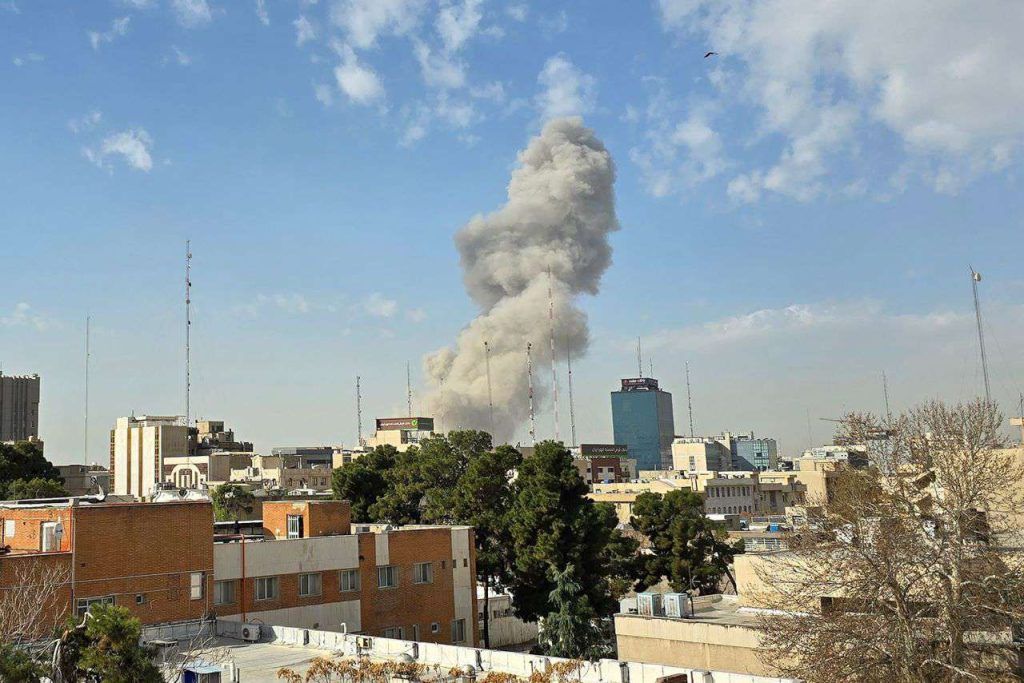
Iran has launched missile and aerial attacks targeting United States military installations in Jordan and Bahrain, sharply escalating tensions across the Gulf region and prompting renewed international calls for restraint.
The strikes, carried out on Wednesday, were confirmed by Iran’s Islamic Revolutionary Guard Corps (IRGC), which said the attacks were in response to recent US military operations against Iranian positions. Tehran also warned neighbouring Gulf states that they bore responsibility for preventing their territories from being used to support US and Israeli operations against Iran.
According to Iranian officials, the strikes involved long-range missile fire directed at US-linked facilities in Jordan, while separate aerial attacks were reported in Bahrain.
Eyewitnesses in Manama, Bahrain’s capital, reported hearing multiple explosions. The Bahraini government later said its air defence systems intercepted and destroyed several incoming projectiles. No casualties were immediately confirmed.
Jordan’s military also said it successfully intercepted five missiles and confirmed there were no reports of deaths or significant damage on its territory.
The Kuwaiti armed forces separately reported heightened air defence activity, saying its systems were engaging unidentified hostile aerial targets amid growing regional alerts.
Iranian authorities said the attacks were part of a broader response to recent US strikes, which Washington described as retaliatory action following the downing of an American Apache attack helicopter. The US military said it had targeted Iranian air defence installations, radar sites, and command centres near the Strait of Hormuz in a coordinated operation.
US Central Command (CENTCOM) confirmed the strikes, stating that American forces had “completed” precision attacks aimed at degrading Iran’s surveillance and air defence capabilities in the region.
Iranian Foreign Minister Abbas Araghchi warned that Tehran would respond to any further aggression, saying Iranian forces would “leave no attack or threat unanswered.”
The confrontation comes amid an already fragile ceasefire arrangement in the Middle East, which has been repeatedly tested by renewed exchanges of fire between Iran, Israel, and their allies over recent months.
Iran’s foreign ministry also issued a stern warning to Gulf states, particularly those along the Persian Gulf, urging them to prevent their territories from being used for military operations against Iran. It described such cooperation as a “legal and moral responsibility” that could draw countries further into the conflict.
The escalation has triggered alarm among global powers. Russia expressed “extreme concern” over the renewed US-Iran hostilities, urging both sides to exercise restraint. China similarly called for de-escalation, warning that continued fighting could destabilise the broader region.
The latest developments come as diplomatic efforts to secure a lasting settlement in the region remain uncertain, despite US President Donald Trump’s claims that negotiations were nearing completion. Trump had previously suggested that a peace agreement could be reached within days, though officials now acknowledge that the situation has deteriorated following the latest round of strikes.
The renewed violence has also heightened fears over the security of key global shipping routes, particularly the Strait of Hormuz, a vital artery for international oil supplies.
Oil markets reacted cautiously to the escalation, with crude prices edging higher amid concerns that prolonged instability could disrupt global energy flows.
Meanwhile, reports from southern Lebanon indicate that parallel clashes involving Israel and Hezbollah continue despite attempts at a truce, further complicating the regional security landscape.
The latest exchange of strikes underscores the fragile and volatile state of Middle East tensions, with fears growing that the conflict could expand further if diplomatic efforts fail to contain the situation.