
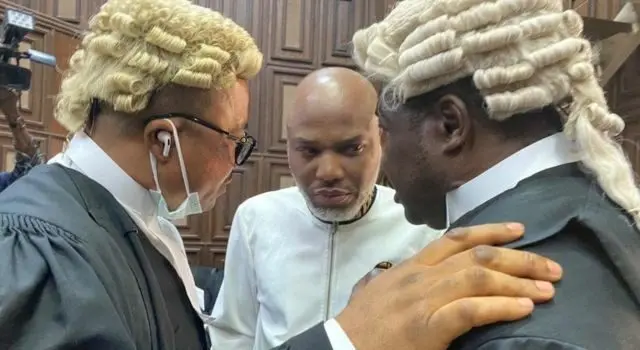
The leadership crisis within the Indigenous People of Biafra (IPOB) intensified on Friday after Chikadibia Edoziem, a senior figure within the group’s Directorate of State (DOS), announced the suspension of the convicted IPOB leader, Nnamdi Kanu, while rejecting claims that he had been removed from office.
Edoziem insisted that Kanu, currently serving a life sentence at Sokoto prison, had been suspended indefinitely as IPOB leader and as director of Radio Biafra, following what he described as a decision taken by members of the DOS.
He also alleged that the suspension was aimed at preventing any actions that could be carried out in the name of IPOB leadership without accountability, claiming there were concerns over alleged external influence on the movement’s leadership direction.
According to him, the move followed a reported meeting involving Kanu and security operatives, which he claimed raised questions within the DOS about the integrity of recent leadership decisions.
Edoziem further argued that the position of IPOB leader had been suspended to protect the organisation from misuse and to reposition its operations.
“No individual of whatever rank or position has the authority to dissolve the DOS of the Indigenous People of Biafra, which is the apex institution overseeing the affairs of the movement,” he said.
He described any claim suggesting a dissolution of the DOS as “null and void” and urged IPOB members and the public to disregard it.
However, the opposing camp loyal to Kanu dismissed Edoziem’s position, insisting that he had been removed from office following a restructuring of the group’s administrative leadership.
In a statement circulated by IPOB spokesperson Emma Powerful and shared by Kanunta Kanu, the group said Kanu had dissolved the third DOS administration led by Edoziem and inaugurated a new leadership structure headed by Chris Nwaọgụ.
The statement said the decision followed what it described as a “careful assessment” of the DOS leadership performance, alleging failures in protecting detained members, safeguarding communication channels, and advancing IPOB’s strategic objectives.
It added that the new DOS had been mandated to restore unity, discipline and organisational focus under Kanu’s directive.
“The third administration fell short of its responsibilities in several fundamental respects,” the statement read.
The new leadership structure, according to the statement, is expected to assume immediate responsibility for the coordination and daily administration of IPOB affairs.
Reacting to Edoziem’s claims, IPOB spokesperson Emma Powerful dismissed the suspension of Kanu as “invalid,” insisting that Kanu remains the undisputed leader of the movement.
“Nnamdi Kanu has been the leader of this movement from the onset. The Edoziem-led group has been sacked,” he said.
The conflicting announcements have further exposed deep divisions within IPOB’s leadership, which has faced repeated internal disputes since Kanu’s arrest in 2015 and subsequent conviction and life sentence for terrorism-related offences last year.
Founded by Kanu in 2012, IPOB has long operated through its Directorate of State as its administrative arm, but the structure has increasingly become a source of factional struggle.
The latest development adds to years of leadership tensions within the group, including earlier disputes involving factional figures such as Simon Ekpa, whose defiance of IPOB directives contributed to wider divisions within the separatist movement.