
Nigeria’s inflation rate rose for the third consecutive month in May 2026, reaching 15.93 per cent amid mounting concerns over global geopolitical tensions, high energy costs, insecurity and persistent supply chain disruptions.
Data released by the National Bureau of Statistics (NBS) on Monday showed that the headline inflation rate increased from 15.69 per cent in April to 15.93 per cent in May, extending the upward trend that began in March after inflation eased slightly to 15.06 per cent in February.
The Consumer Price Index (CPI), which measures changes in the prices of goods and services, rose to 140.7 points in May from 138.3 points in April, indicating a 2.4-point increase in the general price level.
Despite the rise in annual inflation, the pace of monthly price increases slowed. The NBS reported that month-on-month inflation declined to 1.75 per cent in May from 2.13 per cent recorded in April.
According to the bureau, the annual inflation rate remained higher than the 15.69 per cent recorded in April, although significantly lower than the 26.06 per cent posted in May 2025.
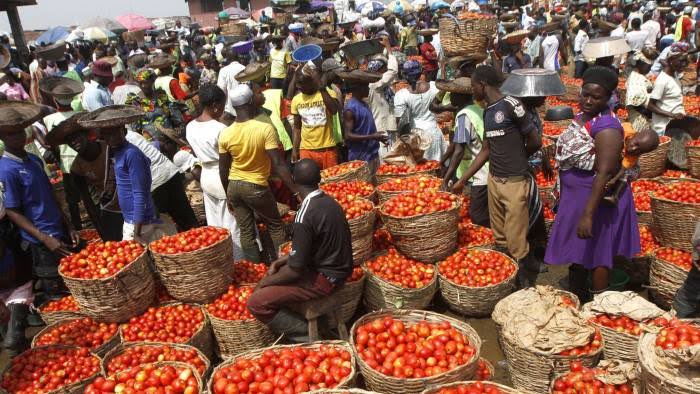
Food prices continued to exert the greatest pressure on household spending, with food inflation standing at 16.96 per cent year-on-year. The NBS attributed the increase largely to rising prices of staple food items, including onions, maize, tomatoes, cassava products, yam tubers, pepper, ginger, plantain and cowpea.
Food inflation, however, moderated on a monthly basis, easing to 2.98 per cent from 3.63 per cent in April.
A breakdown of the inflation basket showed that food and non-alcoholic beverages remained the largest contributor to headline inflation, accounting for 6.38 percentage points. Restaurants and accommodation services contributed 2.06 percentage points, while transportation accounted for 1.70 percentage points. Housing, electricity, gas and other fuels contributed 1.34 percentage points.
Other significant contributors included education services, health care, clothing and footwear, as well as information and communication services.
The NBS also reported that the average inflation rate for the 12-month period ending May 2026 stood at 18.36 per cent, compared to 30.57 per cent during the corresponding period in 2025.
Business leaders attributed the latest inflation increase to a combination of global and domestic factors.
Deputy President of the National Association of Small-Scale Industrialists (NASSI), Mr. Segun Kuti-George, linked the inflationary trend to tensions in the Middle East and disruptions in global oil trade routes.
He noted that the conflict involving Iran and restrictions around the Strait of Hormuz had contributed to higher petroleum-related costs, with adverse consequences for households and manufacturers.
According to him, while petrol prices have moderated slightly in some parts of the country, cooking gas remains beyond the reach of many consumers, with prices ranging between N2,000 and N2,500 per kilogramme in several locations.
Kuti-George expressed optimism that ongoing diplomatic efforts in the region could eventually ease pressure on global energy markets and help moderate inflation.
Similarly, the Chief Executive Officer of the Centre for the Promotion of Private Enterprise (CPPE), Dr. Muda Yusuf, said recent geopolitical developments had continued to affect domestic prices through higher crude oil prices, rising shipping costs, increased marine insurance premiums and import-related expenses.
Yusuf, however, pointed out that monthly inflation indicators suggested a gradual moderation in price increases, noting that both headline and food inflation recorded slower month-on-month growth in May.
He identified food, transportation, housing, energy, health and education as the major drivers of inflation, accounting for nearly 87 per cent of the overall inflation rate.
The economist also highlighted insecurity as a major structural challenge affecting food production, explaining that attacks on farming communities had reduced agricultural output, disrupted supply chains and increased logistics costs.
He urged policymakers to focus on addressing structural impediments to production and distribution rather than relying solely on monetary tightening measures.
President of the Association of Business Owners of Nigeria (ASBON), Dr. Femi Egbesola, echoed similar concerns, citing fuel costs, insecurity and challenges associated with import processes as key inflationary drivers.
Egbesola said insecurity continued to limit farmers’ access to farmlands across several parts of the country, while operational difficulties surrounding the National Single Window platform had increased import costs and contributed to delays that generated additional demurrage charges.
According to him, importers were incurring substantial costs due to delays at the ports, costs that were ultimately transferred to consumers through higher prices.
While welcoming signs of easing tensions in the Middle East, he cautioned that any positive impact on inflation would likely take several months to materialise.
The NBS data also showed that core inflation, which excludes volatile food and energy prices, stood at 16.82 per cent year-on-year in May. On a monthly basis, core inflation accelerated to 1.94 per cent from 1.03 per cent in April, indicating persistent underlying price pressures in the economy.
Urban inflation was recorded at 16.07 per cent year-on-year, while rural inflation stood at 15.60 per cent.
Services inflation remained elevated at 17.92 per cent, reflecting rising costs across key service sectors.
At the sub-national level, Yobe recorded the highest annual headline inflation rate at 24.94 per cent, followed by Anambra at 23.29 per cent and Sokoto at 22.60 per cent.
In contrast, Niger State recorded the lowest inflation rate at 3.07 per cent, with Plateau and Edo posting 7.10 per cent and 7.73 per cent respectively.
Food inflation varied significantly across states, with Adamawa recording the highest annual food inflation rate at 29.62 per cent, followed by Kwara and Rivers states.
The latest inflation figures suggest that although price pressures have eased considerably from the levels recorded a year ago, consumers and businesses continue to grapple with rising costs driven by food prices, energy-related expenses, insecurity and external economic shocks.