
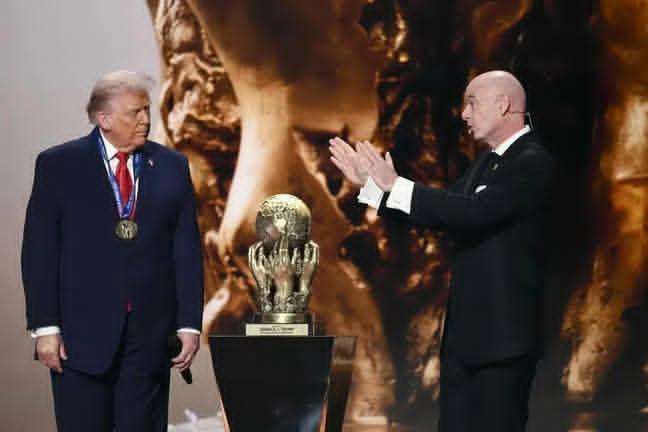
FIFA President Gianni Infantino has dismissed suggestions that political influence played a role in the decision to overturn the suspension of United States forward Folarin Balogun, insisting the ruling was reached independently by the governing body’s judicial authorities.
The decision to lift Balogun’s red-card suspension generated widespread debate after Donald Trump publicly claimed he had intervened on the player’s behalf, fuelling speculation that politics may have influenced the disciplinary process.
Addressing the controversy in a statement on Monday, Infantino reaffirmed that FIFA’s judicial institutions operate independently and are insulated from interference by the organisation’s leadership.
He said the Disciplinary Committee applies the FIFA Disciplinary Code, assesses each case on its merits and reaches decisions without external influence.
According to him, the autonomy of FIFA’s judicial bodies remains fundamental to preserving the integrity and credibility of world football.
Infantino acknowledged that he had received a telephone call from Trump regarding the matter but maintained that the discussion had no bearing on the eventual outcome.
He explained that he regularly engages with political leaders and stakeholders on issues relating to football, particularly as preparations continue for major FIFA competitions.
During the conversation, he said, he merely informed the US president that Balogun’s case was undergoing the established legal process and would be determined solely by FIFA’s independent disciplinary bodies.
The FIFA president stressed that while he may sometimes agree or disagree with disciplinary rulings, he does not interfere with the work of the organisation’s judicial institutions.
He added that respecting those decisions, regardless of personal opinion, is essential to maintaining confidence in FIFA’s governance and competitions.
The controversy has renewed scrutiny of FIFA’s disciplinary framework and longstanding claims of institutional independence.
Following governance reforms introduced after the corruption scandals that rocked world football in 2015, FIFA has consistently maintained that its Disciplinary Committee, Ethics Committee and Appeal Committee operate independently of both the FIFA Council and the president.
The issue has attracted additional attention because it involved direct communication between the FIFA president and the serving US president while a disciplinary case was still pending.
Despite the public debate, neither FIFA’s Disciplinary Committee nor its Appeal Committee has suggested that external representations influenced the outcome, maintaining that the decision was based exclusively on the applicable disciplinary regulations and the evidence presented.
With the suspension overturned, Balogun is now eligible for selection for the United States, although the controversy has reignited wider discussions about the relationship between football governance, judicial independence and political access.