
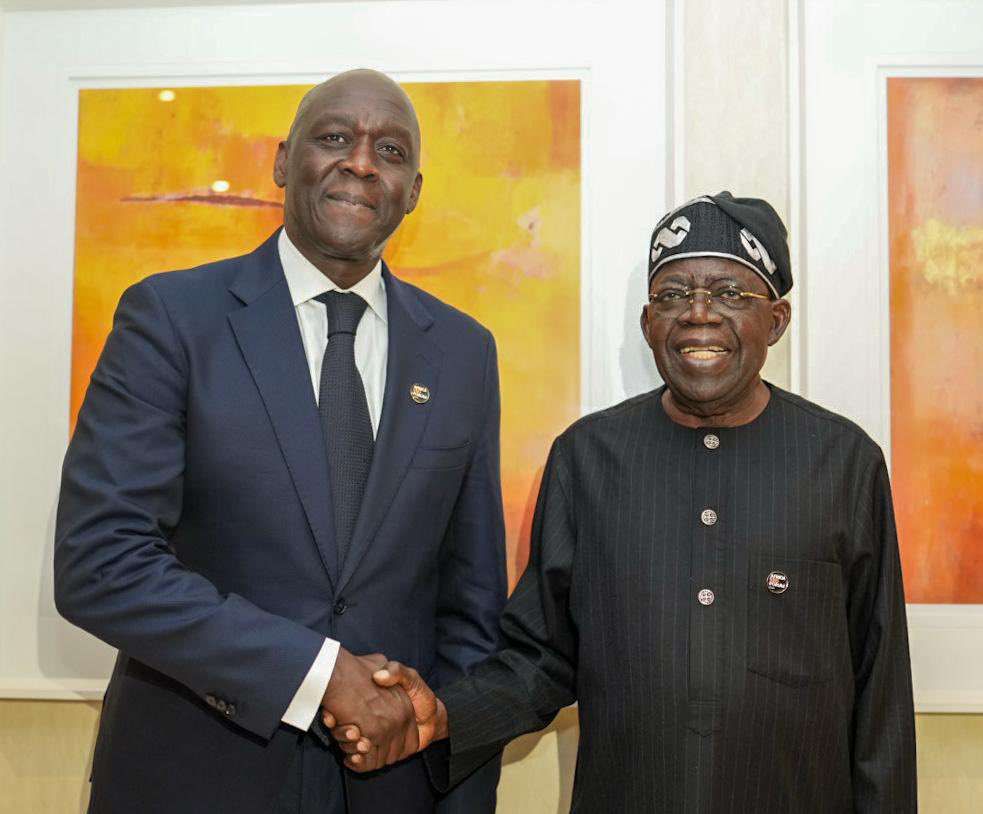
The International Finance Corporation (IFC) has disclosed plans to send a delegation to Nigeria to explore fresh investment opportunities in the livestock, housing and energy sectors as part of efforts to deepen infrastructure financing and expand energy access in the country.
The planned engagement was revealed after a meeting between IFC Managing Director, Makhtar Diop, and President Bola Ahmed Tinubu on the sidelines of the Africa CEO Summit in Kigali.
According to a statement issued by presidential spokesman Bayo Onanuga, the IFC delegation included Regional Vice-President for Africa, Ethiopis Tafara, and Director for Central Africa and Nigeria, Dahlia Khalifa.
Speaking after the meeting, Diop said the IFC was intensifying support for Nigeria’s infrastructure and economic development through public-private partnerships and local currency financing initiatives.
In a post on X, the IFC chief stated that the corporation was advancing a public-private partnership infrastructure pipeline aimed at helping Nigeria tackle its estimated $14bn annual urban infrastructure deficit.
He added that the corporation had completed a landmark cross-currency swap arrangement with the Central Bank of Nigeria and was expanding local currency financing solutions to support the growth of micro, small and medium enterprises.
Diop also disclosed that the IFC was accelerating energy access initiatives in Nigeria under the World Bank Group’s Mission 300 programme by supporting mini-grid and solar power developers.
He further revealed that the corporation was considering investments in water transportation and land transport projects to strengthen regional connectivity between Nigeria and neighbouring countries.
“Inspiring conversation with President Tinubu and Nigerian leadership on our shared development agenda,” Diop wrote.
“IFC is advancing a PPP infrastructure pipeline to help address Nigeria’s $14bn annual urban infrastructure gap, completed a landmark cross-currency swap with the Central Bank of Nigeria, and is expanding local currency solutions to support MSME growth.
“Next on the agenda: water and land transportation projects to strengthen regional connectivity between Nigeria and its neighbours.”
Diop commended Tinubu for the economic reforms introduced by his administration, particularly the removal of petrol subsidy and the unification of the foreign exchange market.
“President Tinubu, you have been so courageous in removing the subsidy. When you did it, I said to myself, President Tinubu took the bull by the horns,” Diop was quoted as saying.
He described Nigeria’s ongoing reform programme as “courageous and transformative,” noting that it had strengthened investor confidence and demonstrated the government’s willingness to implement difficult but necessary economic policies.
Tinubu, according to the statement, reaffirmed Nigeria’s commitment to mobilising private sector capital for infrastructure development and institutional reforms.
The President stressed the need for African countries to transform pension funds into strategic development finance instruments capable of supporting infrastructure projects and investments in productive sectors across the continent.
He said African governments and private sector players must work together to mobilise institutional capital for infrastructure financing, energy transition and long-term economic growth.
“If you want Africa to leapfrog, then energy transmission and decentralisation are important. The funding gap is there, and we must work together,” Tinubu said.
Discussions at the meeting also focused on mechanisms for expanding infrastructure funding through institutional investors, local currency financing structures and swap arrangements.
Diop noted that stronger banking partnerships involving Nigerian financial institutions, including Access Bank Plc, could enhance interstate financial integration and promote trade across Africa.
He also urged African leaders to pursue what he described as an “African Renaissance” driven by strong institutions and regional economic champions.