
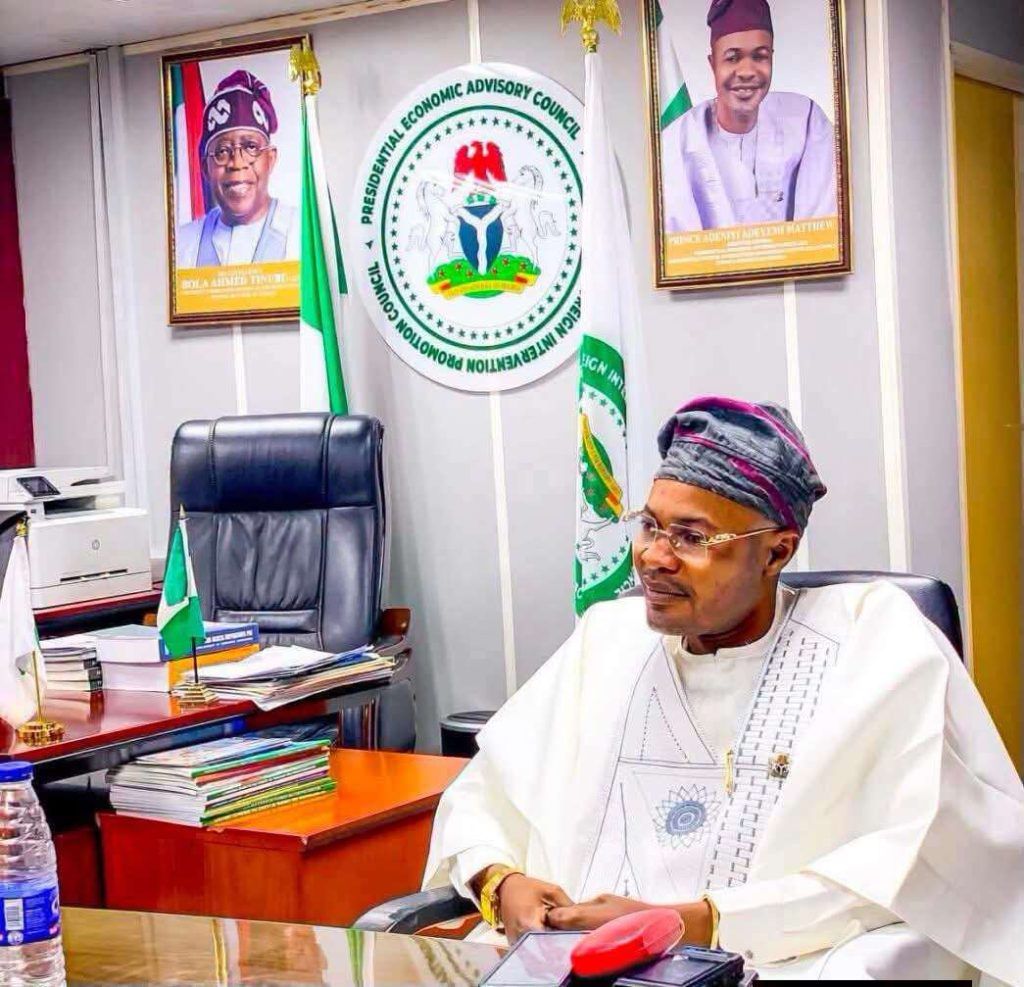
The embattled Director-General of the controversial Presidential Foreign Intervention Promotion Council (PFIPC), Adeniyi Adeyemi Matthew, has defended the establishment of the agency, insisting it was created out of a desire to attract foreign investment to Nigeria and support the administration of President Bola Tinubu rather than for personal enrichment.
Matthew made the claim during a video interview with social media personality Martins Otse, popularly known as VeryDarkMan, amid ongoing investigations into the council, which the Presidency has disowned as non-existent.
He also denied having any role in the inclusion of the council in the 2026 Appropriation Act, saying he was unaware of the budgetary allocation until after it had been approved.
According to him, the office was established to promote Nigeria as a preferred investment destination and strengthen collaboration with government agencies.
“I established that office out of passion for the country. I wanted to bring in foreign investors to Nigeria so that I can write my name in gold. I am just desperate to serve,” he said.
“That agency was established to bring foreign investments to Nigeria and make Nigeria a preferred destination for investors. I worked with ministries, departments and agencies, including the EFCC, to promote investment. It was never about personal interest.”
Matthew said the council had been planning a global investment summit before the controversy surrounding its existence erupted.
He also expressed surprise that the Presidency later denied the existence of the agency despite its appearance in the national budget.
“This whole thing is confusing, especially when the Presidency said the agency does not exist. How then did it find its way into the national budget?” he asked.
According to him, he could not have influenced the budget process because he was in police detention while the budget was being prepared and defended before the National Assembly.
“In fact, I was in detention for 23 days when the budget for the Presidential Foreign Intervention Promotion Council was prepared and defended between October and November,” he said.
Matthew disclosed that he had earlier been invited by the then Inspector-General of Police, Kayode Egbetokun, to explain how he came to head the agency.
He claimed he provided investigators with the identity and contact details of the individual who facilitated his appointment before he was detained.
He added that by the time he regained his freedom on November 19, 2025, he had already been charged to court and the office allocated to the council had been reassigned to another government official.
Responding to questions about the petition filed against him by the Chief of Staff to the President, Femi Gbajabiamila, Matthew denied meeting him over the matter but acknowledged speaking with him on the telephone through a late associate, Dolapo Tanimola.
He insisted he possesses documents supporting the establishment of the council and pledged to submit them to security agencies.
“Any moment from now, I will go to the police and the DSS to submit every document I have to support the investigation,” he said, adding that Tanimola, whom he claimed paid for the establishment of the agency, later died in a hotel fire in Abuja.
The PFIPC became the subject of national controversy after it appeared as one of the beneficiaries of allocations in the 2026 Appropriation Act despite the Presidency maintaining that no such agency exists within the Federal Government.
Following public outrage, the Presidency distanced itself from the council, insisting President Bola Tinubu neither created the agency nor appointed anyone to head it.
The Chief of Staff to the President subsequently petitioned security agencies over the alleged impersonation of the Presidency and the use of forged official documents, leading to Matthew’s arrest and prosecution on allegations bordering on forgery, impersonation and related offences.
Matthew has consistently denied the allegations, maintaining that all documents in his possession were legitimately obtained.
President Tinubu later directed the Independent Corrupt Practices and Other Related Offences Commission (ICPC) to investigate how the council was included in the 2026 budget and ordered that anyone found responsible be prosecuted.
Meanwhile, the Senate has distanced itself from the controversy, insisting the National Assembly neither created nor inserted the budget line for the PFIPC.
Senate spokesperson, Yemi Adaramodu, said lawmakers were not responsible for verifying the authenticity of appointments into ministries, departments and agencies, adding that the dispute remained an executive matter already before the courts.
The controversy has also attracted calls for an independent investigation, with former Vice President Atiku Abubakar and a faction of the Peoples Democratic Party urging the Federal Government to conduct a forensic probe into the circumstances surrounding the agency’s creation and its inclusion in the national budget.