
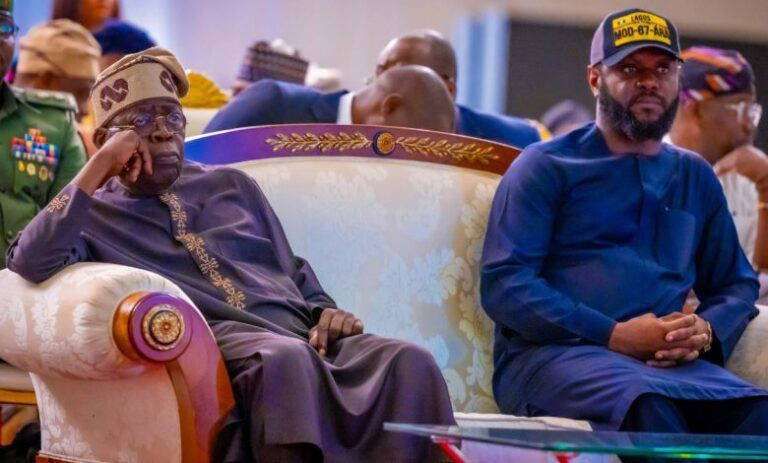
Nigeria’s democracy is growing through a metamorphosis from civil or constitutional or hereditary democracy as political leaders grooming and sponsoring their children to ultimately replace them, actually foreclosing the space of other aspiring Nigerians. Chief Olusola Saraki, former Senate leader imposed his two children, Dr. Bukola Saraki, who became governor and Senate president, as well as Senator Gbemisola Saraki, a sister.
President Bola Tinubu also has imposed his wife as Senator. Before them, there is the Adeleke family in Ede Osun State, whose father, a former regional minister and senator, had produced two governors.
As the 2027 electoral cycle gets near, the political landscape is beginning to come alive and this practice is assuming convention as more and more former governors and leader are set to impose their children on the system. Former vice president Atiku Abubakar has a son in the House of Reps as well as Mallam Nasir El Rufai.
The familiar patterns normally associated with politics are emerging within the nation’s corridors of power. But a new dimension is the ambitions of the scions of popular political families or popular elites that are showing interest in elective offices in the shadows of their fathers.
From the ancient commercial city of Kano to the bustling streets of Lagos and the resilient power hubs of Ogun, a new generation of “political royalties ” is stepping out of the shadows of their influential parents to claim their own at the political arena.
New political Royalties
However, this trend has ignited a fierce debate across the federation: is this a natural progression of leadership and service within families, or a deepening of “dynastic hold on democracy” that stifles fresh perspectives and meritocracy?
The 2027 race will definitely prove a litmus test for these second-generation politicians. Many of them are returning to the fray after previous defeats, armed with lessons learned and deeper pockets. Others are fresh-faced entrants—lawyers, professors, and entrepreneurs—attempting to pivot from their professional successes into the gritty world of elective politics. Already, the teenage sons on FCT minister, Nyesom Wike, is being positioned for selection office, Works minister, David Umahi has his son already elected local government chairman as well as Lagos State Speaker, Mudashiru Obasa son promoted from deputy to chairman local government.
From the North-West to the South-West, the map is being reshaped by names like Abacha, Ganduje, Adefarati, and Buhari. As they declare their intentions, the scrutiny is intensifying. Below is a look at the prominent “children of the rich and powerful” who have confirmed their interest in the upcoming battle for Nigeria’s political soul.
Muhammad Sani Abacha (PDP)
A controversial figure while his father was alive, Muhammad is the son of late Head of State, General Sani Abacha, and is definitely no stranger to Kano politics. A chieftain of the People’s Democratic Party (PDP), Muhammad is bent on making another run for the Kano State governorship in 2027. In spite of the popularity of his family, he had failed in his previous gubernatorial bids especially in 2023 despite securing the PDP ticket and previously running under the CPC.
Nevertheless, he has remained a formidable force, leveraging on his family’s enduring gravitas and influence and a loyal PDP base to win this time around come 2027. Whether he succeeds only time will tell.
Umar Abdullahi Ganduje (APC)
He is widely Known in Kano by his moniker “Abba Ganduje,” Umar Abdullahi Ganduje is the son of the former APC National Chairman and former governor Abdullahi Umar Ganduje.
Abba Ganduje is gunning for a seat at the House of Representatives for the Rimin Gado/Dawakin Tofa/Tofa constituency.
After what was considered a narrow loss in 2023 to Tijjani Abdulkadir Jobe, the battle for a high-stakes rematch is gathering steam. With Jobe now back in the APC, the primary battle between the incumbent and the “crown prince” of the Ganduje dynasty has the potential of being one of the most watched contests in the state come 2027.
Muhammad Daha Umar Faruk
Being a holder of the influential title of Danburam of Daura, Muhammad Daha Umar Faruk is not just your run-of-the- mill politician; he is the personification of the Daura Emirate’s traditional heritage.
As the eldest son of the Emir of Daura, HRH Faruk Umar Faruk, his regal entry into the political battle for the soul of the Baure/Zango Federal Constituency has already changed the political momentum and the dynamic of the local political structure.
Whether he runs under the APC banner or shifts to the African Democratic Congress (ADC), his candidacy represents a bold move by the palace to secure a direct voice in the National Assembly.
He has cautioned his followers to maintain decorum, aware that as a prince, his every move reflects on the throne.
Yusuf Buhari, former president Buhari’s heir
Unarguably we could say that no name carries more gravitas in Katsina than that of Muhammadu Buhari. The recent endorsements of the late former President’s son for the Daura/Sandamu/Mai’adua Federal Constituency seat has elicited a political ferment in the Buhari household. While many of his supporters view him as a worthy heir to his father’s vast political legacy, APC stakeholders have been quick to push back. Reports have it that influential APC stakeholders have bluntly rejected him.
Led by figures like Barrister Usman Ahmed El-Marzuk, party leaders are reported to have held several emergency meetings to reject what they term the “imposition” of candidates.
The struggle here isn’t just about a seat in Abuja; it’s about who gets to guard the Buhari legacy.
While the young Buhari’s name offers instant brand recognition, he faces a stiff challenge from party loyalists, who insist that even the son of a “lion” must win his stripes through a fair and transparent primary process.
Mubarak Ahmad-Gumi (APC)
Outside the confines of Kano theocratic spheres, anything Gumi may be treated as a pariah of sort, but in highly volatile Kaduna where primordial sentiments along faultlines are strong, the entry of a Gumi son into the political race may prove difficult depending on which side of the religious divide one is.
Mubarak is the son of the prominent but highly divisive Islamic cleric, Dr. Ahmad Gumi, and he has indicated interest in vying for a seat in the Kaduna State House of Assembly (Doka/Gabasawa). Currently a legislative aide to the Speaker of the House of Representatives, Tajudeen Abbas, Mubarak is testing whether his father’s vast social influence can translate into electoral success. Time will tell.
Mahmood Mamman Lagos
Mahmood Mamman Lagos is the son of the current Commissioner for Local Government and Chieftaincy Affairs in Kaduna, Sadiq Mamman Lagos. His father is an ally of the state Governor Uba Sani and also a former Local Government Chairman of Kaduna North around year 2000
In the political landscape of Kaduna North, the name Mamman Lagos carries the weight of decades of grassroots influence. Now, a new chapter in that legacy is being written as Mahmood Mamman Lagos formally steps into the spotlight.
Seeking to represent the Doka/Gabasawa Constituency in the Kaduna State House of Assembly come 2027, Mahmood is not just running for a seat; he is carrying the banner of a family that has been a fixture of the metropolis’ power structure since the late 1990s.
Mahmood’s entry into the race under the platform of the All Progressives Congress (APC) is widely seen as a strategic move to consolidate his family’s political capital.
While he is a fresh face in the elective arena, he is no stranger to the inner workings of Kaduna’s governance.
Observers note that his candidacy bridges the gap between the “old guard” of the 1990s and the modern, technocratic administration currently steering the state.
Iyabo Obasanjo (APC)
Iyabo is the daughter of former President Olusegun Obasanjo. She was making a high-profile return to politics, but with the last week consensual endorsement of Senator Adeola Yayi as the gubernatorial flag bearer of APC, Iyabo has since backed out of the race and even congratulated Yayi.
The 59-year-old female politician and former Senator representing Ogun Central is the first daughter of the former president.
Iyabo recently returned to active politics after about 15 years and joined the ruling APC.
The female politician, who represented Ogun Central Senatorial District between 2007 and 2011, participated in the ongoing APC e-registration exercise at Ibogun, Ward 11, in Ifo Local Government Area of the state, effectively sealing her membership of the ruling party.
The renowned epidemiologist and former Ogun State Commissioner for Health lost her re-election bid in 2011 to Senator Gbenga Obadara of the then Action Congress of Nigeria (ACN).
She subsequently returned to the United States to pursue her academic career, rising to the rank of professor.
She is also from Egbaland in Ogun Central, the senatorial district currently pushing strongly to occupy the Oke-Mosan seat after Governor Dapo Abiodun’s tenure.
Olumide Osoba (APC)
Olumide is the son of a deity in journalism, the veteran journalist and former governor Segun Osoba.
He is seeking a fourth term in the House of Representatives. Representing Abeokuta North/Odeda/Obafemi-Owode.
His ambition has been polarizing defined by support for his experience on the one hand, and local controversy over demands for power-shifting among the local governments in his constituency on the other hand.
His constituency compromises three LGs – Abeokuta North, Odeda and Obafemi – Owode, where he hails from.
Damilola Ayinde-Marshal (APC)
Trading the courtroom for the political turf, the daughter of Fuji legend, King Wasiu Ayinde Marshall (KWAM 1), has declared for the Lagos State House of Assembly.
A lawyer of 12 years, she is gunning to represent Surulere Constituency 2, positioning herself as a “woman of excellence” and a voice for the youth.
The lawyer shared her plans in an Instagram post via her handle, expressing her commitment to serve the people of Surulere Constituency 2.
“I am excited to share that I, Barr. Damilola Ayinde Marshal, am stepping forward to serve the good people of Surulere Constituency 2 at the Lagos State House of Assembly,” she wrote.
Damilola, who has practised law for 12 years, said her professional experience has shaped her understanding of governance, justice, and the needs of her community.
“I am a woman of excellence and results. I am ready to serve and lead. With my background, I am fully prepared and ready to fight for what truly matters. I promise to be the voice of the youths in the House.
Olamiju Alao-Akala
Olamijuwonlo Alao-Akala, member of the House of Representatives and son of the late former Oyo State Governor Adebayo Alao-Akala, is reportedly gunning for a second term in 2027.
He currently represents Ogbomoso North/Ogbomoso South/Oriire federal constituency.
Some of his supporters highlighted his work in road rehabilitation, health outreach, and youth-focused legislation.
He has experience as a former local government chairman and serves as the House Committee Chair on Youth.
Gboyega Adefarati
Gbenga is the son of former Ondo State Governor, Adebayo Adefarati. He currently serves as a member of the House of Representatives, representing Akoko South East/Akoko South West Federal Constituency of Ondo State in the 10th National Assembly.
He is the Chairman of the House of Representatives Committee on Labour, Productivity and Employment.
The 60-year-old federal lawmaker is currently aspiring for another term.
Nothing wrong with children of elites contesting – Prof Fage
Professor Kamilu Sani Fage of the Department of Political Science, Bayero University Kano, has said there is nothing wrong with children of politicians, wealthy individuals, traditional rulers, and clerics contesting for elective positions.
Speaking on the trend of increased participation of elites’ children in politics, Fage noted that the Nigerian constitution guarantees every citizen the right to vote and be voted for, regardless of social status, religion, or gender.
He explained that the only concern arises when the privileged background of such candidates is used to tilt the playing field in their favor.
“The problem is when their social status is used to give them an advantage over others. That is when you can talk about it, maybe when there is no level playing ground,” he said.
According to him, democracy thrives on fairness, and any attempt to use wealth, ruling family ties, or godfatherism to suppress others undermines the process.
“Anybody can contest. The only implication is when their position is used to their own advantage and to the disadvantage of others,” he added.
Fage stressed that, beyond such distortions, the participation of elites’ children in politics should be seen as part of democratic practice.
Dr Abiola Anjorin, a political scientist told Business Hallmark that “the idea of children of the rich making effort to take over leadership from their fathers is for the perpetuation and expansion of their family legacies.
“It’s a simple game geared toward the expansion of family legacies and name. They (the wealthy political class) groom their children to continue with what they are doing. They don’t want to leave their children at a disadvantage in the long run because they want to maintain fame, influence, and affluence.
“The implication of this is that those people who should be in contention for political seats will retain their followers because of their wealth and influence.
“It portends continuity of what we see today. For instance, if their fathers were deep into corruption, the trend will continue, and this will become a normal thing.”