
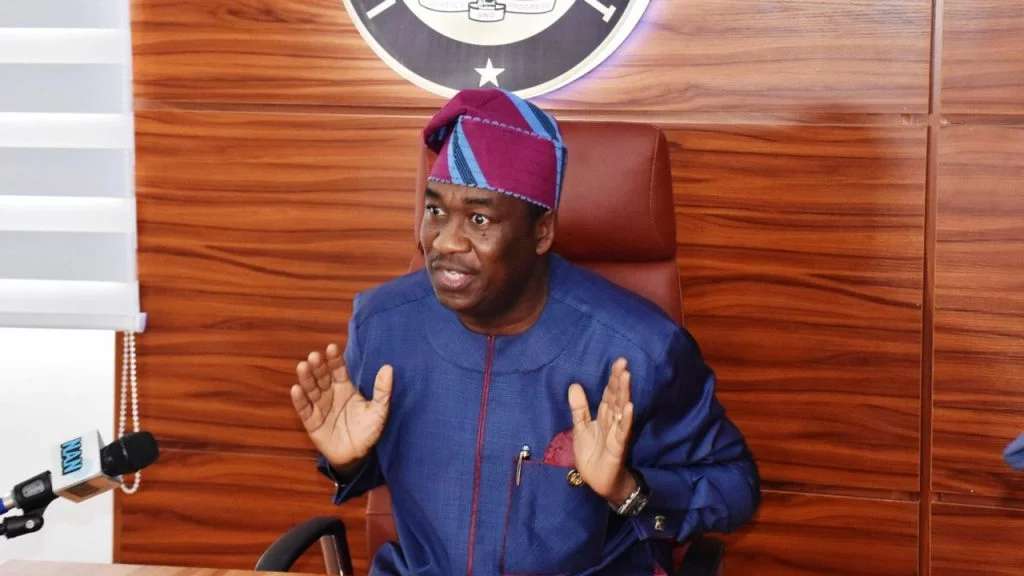
The governorship candidate of the All Progressives Congress (APC) in Lagos State, Dr Obafemi Hamzat, has dismissed speculations that he entered into an agreement to serve only one term if elected governor in the 2027 election.
Hamzat, who currently serves as deputy governor of the state, also outlined his vision for Lagos, promising to prioritise security, improved water supply, infrastructure, urban planning and youth development if elected.
Speaking in an interview published by Vanguard on Monday, the APC candidate said there was no pact limiting his tenure to four years.
Asked whether there was an agreement for him to spend only one term in office, Hamzat replied: “Agreement? No, there’s no agreement.”
The deputy governor said his primary responsibility, if elected, would be to ensure that government policies and programmes directly improve the lives of Lagos residents.
According to him, the governor’s role is to coordinate experts across different sectors and align government policies with a clear vision that delivers measurable benefits to the people.
“The job of the governor is to make sure that, in terms of delivery, everything we do from that budget to implementation affects the quality of life of the Lagosians,” he said.
Hamzat disclosed that his campaign manifesto had been developed and was undergoing further review after consultations with different interest groups, including market women, transport operators, academics and professionals.
He said the original document, which exceeded 500 pages, had been condensed to focus on practical priorities that could realistically be implemented over a four-year period.
Among his key targets, Hamzat said his administration would work towards ensuring that at least 60 per cent of Lagos residents have access to running water within the first two years in office.
He noted that rehabilitating water distribution infrastructure, including damaged pipelines linking the Adiyan 2 Water Works to parts of the state, would require significant investment, estimated at about ₦97 billion.
The APC candidate also identified security as a major priority, pledging to expand the state’s existing security architecture through the deployment of technology to safeguard lives and property.
He said improved street lighting, better urban planning and stronger law enforcement would help create a safer environment that allows residents to move freely and conduct business without fear.
Hamzat also stressed the need for greater discipline and adherence to the rule of law, arguing that public infrastructure must be used for its intended purpose.
“When we build roads and there is a walkway, let’s use it for a walkway. When we say this is a market, let it be a market,” he said.
On concerns over managing street trading, touting and blocked drainage channels, Hamzat said enforcement of the rule of law, backed by technology, remained the most effective solution.
He maintained that public interest must take precedence over individual considerations in urban management.
The deputy governor said his administration would continue the work of the outgoing Sanwo-Olu administration, describing government as a continuous process rather than one that ends with a particular administration.
According to him, the immediate task of the current administration is to complete ongoing projects and ensure a smooth transition for the next government.
Speaking on his emergence as the APC governorship candidate, Hamzat said he accepted previous political decisions in the party in good faith, insisting that leadership ultimately rests with God.
He recalled stepping down during the 2019 governorship selection process after party leaders advised that the ticket should go to a Christian following successive Muslim governors in the state.
Hamzat said that decision eventually paved the way for him to become deputy governor.
He appealed to aggrieved aspirants following the party’s recent primaries to remain calm, saying efforts were already underway to reconcile dissatisfied members.
According to him, several considerations, including gender balance and political inclusion, often influence candidate selection beyond individual ambition.
Explaining the choice of his running mate, Damilola Sonayon-James, Hamzat said the APC deliberately opted for a female Christian from Lagos West to complement his own profile as a Muslim from Lagos East.
He said the decision also reflected the party’s desire to give younger leaders greater opportunities.
The APC candidate also sought to allay concerns over possible rivalry between him and Governor Babajide Sanwo-Olu after a transfer of power, saying their longstanding friendship and working relationship made such a scenario unlikely.
“We have been friends for years,” he said, adding that disagreements within government were normal but were resolved in the interest of the state.
Hamzat rejected the perception that deputy governors merely play ceremonial roles, saying he had exercised significant responsibilities overseeing ministries such as Works as well as Science and Technology.
He promised that his deputy would equally be given meaningful responsibilities if elected governor.
On the recurring problem of building collapse in Lagos, Hamzat said the state government was strengthening oversight through its Certified Accreditors Programme, which would involve registered private professionals monitoring construction projects alongside government agencies.
He said the initiative was intended to eliminate the collapse of newly constructed buildings by ensuring that only certified professionals supervised developments.
Hamzat also threw his weight behind President Bola Tinubu’s expected re-election bid in 2027, arguing that the President was laying the foundations for long-term economic growth despite current challenges.
Comparing Tinubu with other leading opposition figures, including Peter Obi, Atiku Abubakar and Rabiu Kwankwaso, Hamzat questioned their records in previous public offices and expressed confidence that Nigerians would return the President to office for a second term.
He said although ongoing reforms were difficult, they were necessary to reposition the country’s economy and improve future prospects.