
In recent years, the conversation about Southeast Nigeria has undergone a notable transformation. What once centered largely on the activities of the Indigenous People of Biafra (IPOB)—particularly secessionist rhetoric and disruptive sit-at-home orders that strained economic and social life—has gradually shifted toward more constructive and forward-looking themes.
Today, public discourse increasingly highlights education, technology, gas exploration, and infrastructure development. This shift reflects a broader realization that lasting progress is built not through division, but through strategic investment in people, knowledge, and regional development.
A tweet from one observer captures this changing mood succinctly: “So glad we moved from discussing IPOB to discussing education, tech, gas, infrastructure in the southeast.” The sentiment underscores a growing collective aspiration for stability, opportunity, and prosperity in the region.
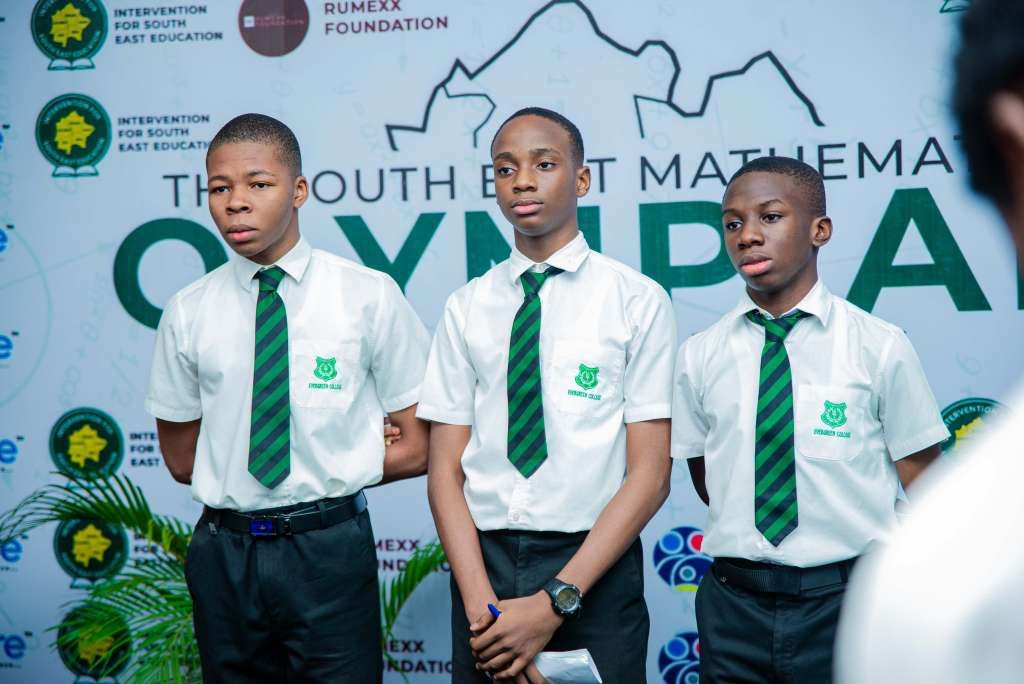
Three boys from Evergreen school Enugu that topped the Junior Category in South East Maths Olympiad Grand Finale.
At the heart of this evolving narrative is education, which is widely seen as the foundation for sustainable growth. By prioritizing learning, innovation, and skills development, Southeast Nigeria appears to be redefining its future—one grounded not in conflict, but in progress.
At the forefront of this educational revival stands Alex Onyia, the visionary CEO of Educare, Nigeria’s leading EdTech platform. Onyia, often hailed as the “Sultan of Software,” has dedicated his career to leveraging technology to democratize learning. Educare reaches over one million students and 300,000 parents daily, providing digital tools that enhance teaching and learning across the country. His focus on the Southeast stems from a deep personal connection; born in Enugu, he witnessed firsthand the region’s untapped potential amid challenges like high illiteracy rates and outdated infrastructure. Through Educare and his nonprofit arm, the Intervention for South East Education (ISEE), Onyia has championed initiatives that make education the most accessible path out of stagnation.
Onyia’s efforts span more than a decade, but his targeted interventions in the Southeast intensified around 2023, following revelations of systemic issues in national exams like JAMB, where Southeast students faced unusually high failure rates. He took legal action against JAMB, advocating for transparency and fairness, which led to reviews of their systems with support from figures like Chief Osita Chidoka. Since then, his work has expanded across primary, secondary, and tertiary levels. At the primary level, ISEE’s “One Child, One Desk” project equips schools with essential furniture to create conducive learning environments. In secondary schools, he has shipped high-quality textbooks, such as A1 English and Abbot Physics, and provided online courses and mentorship programs. For tertiary aspirants, his initiatives have dramatically improved outcomes; in his village in Enugu State, JAMB pass rates flipped from 75% failure to overwhelming success through targeted support.

Egejurum Onyedikachi, Onwubiko Chimdiebube and Don-Anele Marvelous Munachimso
Beyond resources, Onyia has led physical renovations of educational facilities. Under ISEE, schools in Anambra, Enugu, Imo, Abia, and Ebonyi have seen upgrades, including modern classrooms and tech-equipped labs. This holistic approach counters the inertia of sit-at-home orders, which once disrupted schooling and fostered idleness. Instead, Onyia promotes a “Get Intellectually Occupied” mandate, encouraging students to engage deeply with knowledge as a tool for empowerment. As he shared in an interview, “I see my country’s education system develop rapidly like that of Singapore and Finland. What we are currently doing in the South East will be infectious to the rest of Nigeria and Africa.” His vision aligns with sustainable business principles, where investments in education yield long-term economic dividends through a skilled workforce.
A pinnacle of these efforts was the just-concluded South East Maths Olympiad, a landmark event organized by Onyia and Educare in collaboration with ISEE. Launched in September 2025, the competition engaged over 11,500 students from the five Southeast states in a fully computer-based testing format, ensuring accessibility for children from diverse backgrounds. The Olympiad emphasized equity, with every registered participant competing regardless of economic status. It culminated in a grand finale on March 7, 2026, in Enugu, where results were announced seamlessly via live stream, showcasing zero glitches in the process.
In the primary category, Egejurum Onyedikachi from Diamond Special School in Owerri, Imo State, emerged as the winner, rising from among thousands to claim the top spot. The competition drew widespread acclaim, with prizes including ₦5 million for first place, ₦3 million for second, and ₦2 million for third in the student categories, plus ₦1 million each for winning teachers. Support poured in from donors, foundations, and media outlets, highlighting the event’s role in fostering deeper learning and inclusivity. Personalities like Enugu’s Governor Peter Mbah and other regional leaders praised it as a model for youth engagement. One observer noted on X: “Alex Onyia’s vision and dedication are setting the stage for the next generation of brilliant minds.”
This Olympiad marks a triumphant moment for the Southeast, demonstrating how education can unite communities and drive progress. It stands as a beacon for other zones to emulate, proving that targeted, tech-driven initiatives can transform regions. The South East Development Commission (SEDC) echoes this, linking its ₦140 billion 2026 budget to a “new patriotism” in the region, where even former separatist sympathizers now engage in development efforts. Infrastructure projects, like improved roads and gas pipelines, complement these educational strides, creating a synergistic path to prosperity.
Across Nigeria, similar initiatives have empowered millions over time. In the North, the Northern Education Initiative Plus (NEI+) has improved early reading and math skills for over 225,000 students in Bauchi and Sokoto since 2009, focusing on teacher training and support for orphans. The Partnership for Learning for All in Nigeria (PLANE), funded by the UK, targets foundational learning in states like Kano and Jigawa, emphasizing inclusivity for girls and children with disabilities. Education Cannot Wait (ECW) provides vocational training and safe learning spaces in conflict-affected areas, reintegrating out-of-school children. NGOs like Slum2School have supported thousands in Lagos slums with scholarships and tech access since 2012, while Dream Catchers Academy uses arts to educate orphaned girls. The Adolescent Girls’ Initiative for Learning and Empowerment (AGILE) in Katsina has enrolled 15 million girls nationwide, incorporating digital literacy and sustainability programs. These efforts have historically boosted enrollment, reduced dropout rates, and enhanced economic opportunities, as seen in NEI+’s impact on regional stability.
Onyia’s model offers verifiable history and sustainable business insight: Education investments return multifold through innovation and productivity. As he stated in a YouTube discussion, “We continued the journey, and a lot more schools started adopting it across different regions.” By prioritizing verifiable data, like CBT exam integrity and community involvement, these initiatives ensure longevity. The Southeast’s story inspires a national blueprint, where education replaces discord, paving the way for a united, thriving Nigeria.