
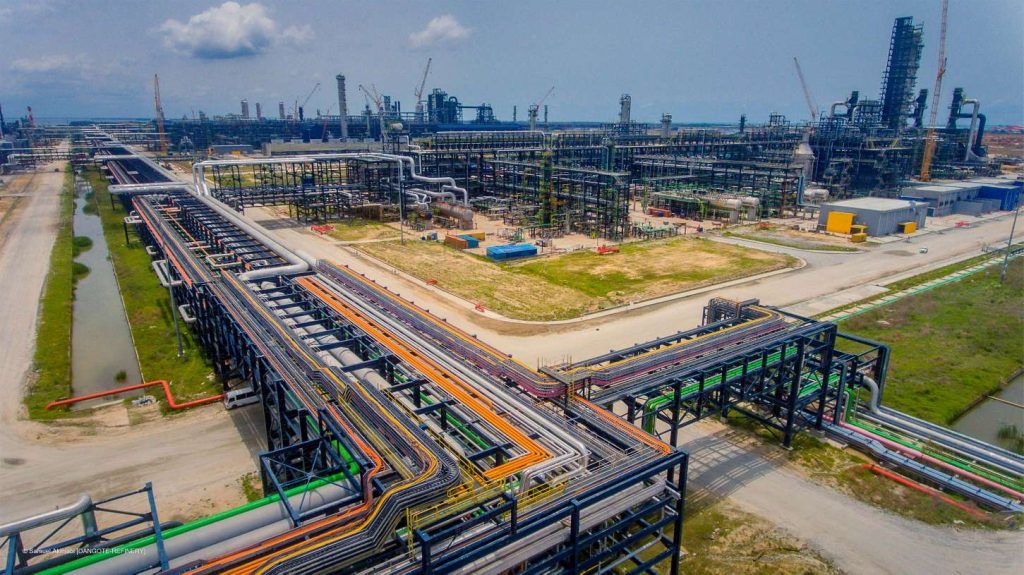
The Dangote Petroleum Refinery obtained nearly four-fifths of its crude oil requirements from Nigerian producers between May and June 2026, underscoring the growing role of domestic feedstock in supporting operations at Africa’s largest refinery.
Analysis of the refinery’s cargo discharge and pricing records for the two-month period showed that Nigerian crude grades supplied about 78 per cent of the refinery’s total crude intake, while imported barrels from countries including Libya, Angola, Guyana and Ghana accounted for the remaining 22 per cent.
The data, released by the refinery, also sought to clarify concerns about its fuel pricing model, stressing that crude purchases are typically made weeks or months ahead under contracts tied to monthly average prices rather than daily spot market fluctuations.
According to the records, the 650,000-barrels-per-day refinery received 40.40 million barrels of crude oil during May and June. Of this volume, 31.43 million barrels came from Nigerian oil fields, while 8.97 million barrels were sourced from foreign suppliers and international trading blends.
The refinery took delivery of 21.47 million barrels in May and 18.93 million barrels in June.
In May, domestic crude accounted for 16.74 million barrels, representing 77.97 per cent of total supplies, while imported barrels stood at 4.73 million barrels, or 22.03 per cent. In June, Nigerian crude deliveries totalled 14.69 million barrels, equivalent to 77.58 per cent of feedstock requirements, with foreign supplies contributing 4.24 million barrels, or 22.42 per cent.
The local grades processed during the period included Bonny Light, Qua Iboe, Forcados, Amenam, Bonga, Escravos, Agbami, Cawthorne, Okwori and Utapate.
Imported crude grades comprised Libya’s El Sharara, Angola’s Cabinda, Guyana’s Payara and Ghana’s Jubilee, alongside internationally traded blends.
A breakdown of supplies showed that Bonny Light was the refinery’s largest single source of crude during the period, contributing 5.90 million barrels. Qua Iboe followed with 4.80 million barrels, while Amenam supplied 4.00 million barrels and Forcados delivered 3.89 million barrels.
Together, the four Nigerian grades accounted for more than 18.5 million barrels, nearly half of the refinery’s total crude intake during the two months.
Other local streams included Escravos with 1.99 million barrels, Utapate with 1.90 million barrels, Cawthorne with 1.89 million barrels, Bonga with 1.03 million barrels and Agbami with 1.00 million barrels. Okwori contributed 418,462 barrels, while ABO supplied 697,403 barrels.
Among foreign suppliers, Libya emerged as the largest source, providing 2.10 million barrels, representing about 5.2 per cent of total feedstock. International trading blends, including CJ Blend and EA Blend, supplied a combined 2.95 million barrels.
Guyana delivered 1.02 million barrels of Payara crude, while Angola supplied 996,349 barrels of Cabinda crude. Ghana’s Jubilee grade accounted for 956,001 barrels, and cargoes delivered under the Chile Prosperity designation added 948,917 barrels.
The records also highlighted a significant decline in crude acquisition costs between May and June.
In May, some cargoes of Qua Iboe and Bonga crude were priced above $134 per barrel, pushing the total value of crude purchases for the month to about $2.68 billion.
By June, however, most cargoes were acquired at between $90 and $97 per barrel, although Angola’s Cabinda crude was delivered at $123.30 per barrel. As a result, total crude procurement costs for June fell to approximately $1.80 billion.
The drop reflected broader trends in the international oil market, where prices eased amid concerns over slowing global demand, reduced geopolitical tensions and increased output from major producers.
The lower feedstock costs are expected to improve refining margins and strengthen the refinery’s competitiveness in both domestic and export markets.
The development comes as the Federal Government and industry regulators intensify efforts to enforce the domestic crude supply obligation framework aimed at guaranteeing adequate feedstock for local refineries.
The Dangote refinery had previously expressed concerns over challenges in securing sufficient volumes of Nigerian crude, forcing it to supplement supplies with imports from international markets.
Despite those concerns, the latest figures indicate that local crude remains the foundation of the refinery’s operations.