
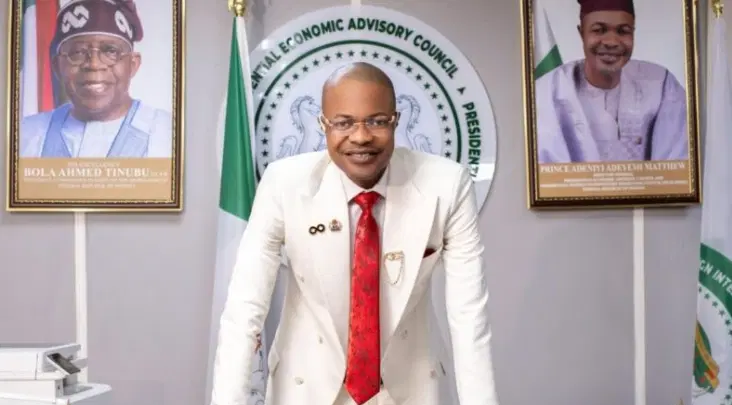
The Central Bank of Nigeria (CBN) has told the House of Representatives that it opened two domiciliary accounts for the controversial Presidential Foreign Investment Promotion Council (PFIPC) on the instruction of the Office of the Accountant-General of the Federation (OAGF), adding that the accounts have remained dormant since they were created.
The disclosure came on Monday during the inaugural sitting of the House ad hoc committee investigating the legal status, operations and budgetary inclusion of the council, whose existence has sparked nationwide controversy.
Representing the CBN Governor before the committee, Director of Banking Services, Hamisu Abdullahi, said the apex bank acted only after receiving a formal mandate from the OAGF.
According to him, the bank received a letter dated July 29, 2025, directing it to open two foreign currency accounts for the Presidential Economic Advisory Council/Presidential Foreign Investment Promotion Council.
“On the 30th of July 2025, we received a mandate dated 29 July 2025 from the Office of the Accountant-General of the Federation to the Central Bank of Nigeria to open two domiciliary accounts for the Presidential Economic Advisory Council/Presidential Foreign Investment Promotion Council,” Abdullahi said.
He explained that the CBN carried out its standard verification process before opening a United States dollar account and a Pound Sterling account for the council.
“Based on that mandate, we did the normal verification to confirm the genuineness of the mandate… Two accounts were actually opened… Those two accounts remain inactive with zero balance and have never been operated,” he added.
Abdullahi further disclosed that there had been no financial activity on the accounts.
“There have been no foreign exchange allocations, no remittances, no inflows and no outflows. The accounts have maintained zero balance from inception to date,” he said.
He clarified that the apex bank opens and manages accounts for Ministries, Departments and Agencies only upon authorisation from the OAGF and does not deal directly with MDAs on such matters.
The testimony appeared to contradict earlier claims that the council fraudulently secured the accounts without proper authorisation.
Head of Service denies role
Also appearing before the committee, Head of the Civil Service of the Federation, Didi Esther Walson-Jack, distanced her office from the establishment of the disputed council.
She said creating government agencies does not fall within the mandate of the Office of the Head of the Civil Service, although it is responsible for approving organisational structures of agencies already established.
According to her, the council applied for approval of its organisational structure in August 2025, but the request was not granted because it failed to provide the required documentation.
She, however, disclosed that officials of the council later sought approval for manpower during the 2025 annual personnel budget exercise, claiming that 14 officers, including a Director-General, were already working with the organisation.
The request, she said, was processed alongside submissions from other agencies, leading to approval for 314 positions, comprising the 14 existing staff and 300 additional slots.
Walson-Jack said subsequent checks revealed irregularities in the legal documents submitted by the council.
“It was observed that the document presented by the council as its enabling law or legal instrument did not really carry the requisite features,” she told lawmakers.
She also denied reports that her office deployed personnel to the council or allocated office accommodation for it at the Federal Secretariat.
Abbas seeks facts, not speculation
Inaugurating the committee, Speaker of the House of Representatives, Tajudeen Abbas, said the investigation was aimed at establishing facts surrounding the council rather than validating public speculation.
“The House of Representatives has therefore not constituted this committee to validate speculation or amplify controversy. Neither is this a political exercise. Our objective is simply to establish the facts,” Abbas said.
He said the committee would determine whether the council was lawfully established, whether due process was followed in its inclusion in the federal budget and whether its functions duplicated those of existing government agencies.
The Speaker urged all invited public officials to cooperate fully with the investigation.
“This House expects the truth, not rehearsed scripts or defensive posturing. Nigerians deserve candour. They deserve explanations that withstand scrutiny,” he said.
Chairman of the committee, Rep. Yusuf Gagdi, assured Nigerians that the investigation would be conducted fairly and transparently.
“Our mandate is to objectively examine the circumstances surrounding the alleged establishment and operations of the Presidential Foreign Investment Promotion Council, determine whether due constitutional and statutory processes were followed,” Gagdi said.
The committee has directed the CBN to submit detailed records relating to the council’s accounts and invited several senior government officials, including the Ministers of Finance, Budget and Economic Planning, Justice, Foreign Affairs and Industry, Trade and Investment, as well as the Secretary to the Government of the Federation, the Accountant-General, the ICPC, EFCC, DSS and the Inspector-General of Police.
ICPC questions Gbajabiamila
Meanwhile, the Independent Corrupt Practices and Other Related Offences Commission (ICPC) has questioned the Chief of Staff to the President, Femi Gbajabiamila, over allegations linked to the disputed council.
The allegations stem from claims by the self-acclaimed Director-General of the PFIPC, Prince Adeniyi Adeyemi, who alleged that he paid N400 million to secure his appointment and that a percentage of the council’s proposed take-off grant was demanded from him.
Gbajabiamila has denied the allegations and instituted a N15 billion defamation suit against Adeyemi.
Confirming his appearance before investigators, Gbajabiamila’s lawyer, Jiti Ogunye, said his client honoured the ICPC’s invitation in compliance with President Bola Tinubu’s directive for a thorough investigation.
“My client gave his testimony, responded to questions accordingly, and has returned to his duty post,” Ogunye said.
The PFIPC controversy erupted after over N1.3 billion was found allocated to the council in the 2026 Appropriation Act despite questions over its legal existence, prompting investigations by both the National Assembly and anti-corruption agencies.