
Nigeria has long distinguished between two kinds of inherited wealth. On one side stand the children of the country’s founding-era elite the scions of Obafemi Awolowo, Nnamdi Azikiwe, and their contemporaries ,whose family fortunes were built, however imperfectly, through business, law, and diplomacy. Call them nepo babies in the conventional sense: beneficiaries of legitimate accumulated advantage. On the other side stands a newer and uglier phenomenon: the children of modern politicians who have systematically looted public funds, inflating their dynasties not through enterprise but through graft. For these, a term has begun to circulate: “Lapo babies.”
The distinction matters because of what it exposes about opportunity in Nigeria. While the old money nepo baby may benefit unfairly from family connections, the Lapo baby is the product of something far more corrosive: public resources diverted from classrooms and hospitals to fund a private parallel society. Nowhere is this clearer than in the question of education ,specifically, who gets to study abroad, and with whose money.
The Bello and Ibori Cases: A Blueprint for Plunder
The allegations against Yahaya Bello, the former governor of Kogi State, offer the starkest illustration. The Economic and Financial Crimes Commission (EFCC) has accused Bello of siphoning ₦80.2 billion in public funds. Among the specific charges: more than $760,000 in prepaid school fees at the American International School in Abuja , a dollar-denominated institution that, for most
Nigerians, might as well be oversea, overing his children Zayan, Zara, Farid, Na’ima, and Nana Fatima through to graduation. Individual tabs included $90,074 for Farid and $87,470 for Zara, all paid in US dollars while Kogi’s own schools deteriorated. Bello denied the allegations; the school subsequently refunded the payments to the EFCC.
James Ibori’s case is even better documented. The former Delta State governor was convicted in the United Kingdom in 2012 for laundering nearly £50 million, roughly $77 million at the time. Court proceedings revealed a sprawling architecture of hidden assets: stakes in companies including Oando, properties in South Africa and Texas, and school fees at exclusive Dorset boarding schools for his children, paid out of proceeds from oil-rich Delta’s public purse. His wife, sister, and mistress were separately jailed for their roles in the scheme. Meanwhile, Delta’s classrooms went unrepaired.
These are not aberrations. They are, as the pattern of the past two decades suggests, something closer to a standard operating model.
The Roll Call: Who Sent Their Children Abroad
The list of senior Nigerian officials whose children have received foreign educations, at costs far beyond any conceivable official salary, is long and largely bipartisan. Former Senate President Bukola Saraki’s daughter graduated from the London School of Economics in 2017, at an annual
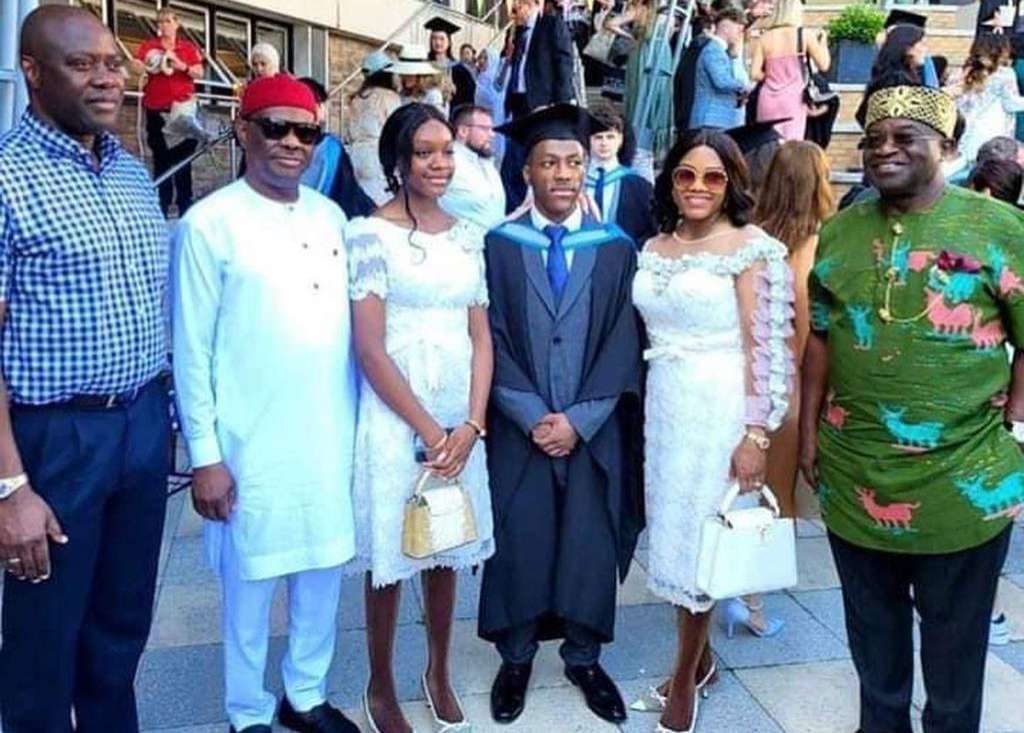
tuition of approximately $35,000. Former Deputy Senate President Ike Ekweremadu’s daughter Sonia attended the University of Coventry, graduating in 2019 at around $20,000 per year. Senator Dino Melaye’s children studied at British institutions at roughly $25,000 apiece; former Rivers Governor Nyesom Wike’s son Jordan attended the University of Exeter at $28,000 annually.
Others on the list include Kaduna’s former governor Nasir El-Rufai (son Ahmad, UK, 2022), Jigawa’s Badaru Abubakar (son Mohammed Sani, Brunel University, $22,000), Ogun’s Gbenga Daniel (son Mayo, University of London, 2022), and Ebonyi’s David Umahi (son, University of Surrey). President Bola Tinubu’s son Seyi was educated in the UK and United States. Former President Muhammadu Buhari’s daughters attended British universities: Zahra at Surrey (2016), Nana-Hadiza at Buckingham, Safinatu at Plymouth and Arden, and Halima at Leicester. Former Vice-President Yemi Osinbajo’s daughter studied in the UK. Peter Obi’s son Oseloka attended the University of Bristol. The list continues.
The Numbers: A Nation’s Wealth, Redirected
The individual cases aggregate into a significant macroeconomic phenomenon. Foreign education for a politician’s child typically costs between $40,000 and $60,000 per year in tuition alone; add living expenses and the annual bill reaches $100,000 or more per child. Central Bank of Nigeria (CBN) data shows Nigeria spent $1.39 billion on foreign education in the first half of 2025 alone. Between 2020 and mid-2025, capital outflows linked to foreign education totalled $11.1 billion,a figure that dwarfs the federal government’s entire N2.52 trillion education budget for 2025. Over the decade from 2010 to 2020, an estimated $28.65 billion left the country for foreign schooling and healthcare combined, part of a broader $40 billion outflow.
These are not the expenditures of a country that has adequately funded its own universities. They are, rather, the expenditures of an elite that has consciously opted out of the public systems its members were elected to maintain.
The Candlelit Student and the Inherited Advantage
The contrast is not abstract. Every ASUU strike that keeps Nigerian federal universities shuttered for months , sometimes an entire academic year, is a disruption that leaves the politician’s child untouched. Every power outage that forces secondary students to study by candlelight is a hardship that produces, among those who endure it, an odd point of generational pride: “I did it, I survived it, so you can too.” This attitude, understandable as coping mechanism, functions as an ideology of acceptance ,one that has helped normalise the systematic underfunding of public education across decades.
The consequences for labour market outcomes are tangible. A first-class honours degree from an engineering programme at Imo State University, Kwara State University, or Lagos State University represents genuine academic achievement. But it does not come with the global internships, professional networks, or international accreditation that open doors at multinationals, top-tier consulting firms, or major financial institutions. The foreign-educated Lapo baby , whatever the provenance of the fees , enters the job market with structural advantages that have nothing to do with individual merit. The result is brain drain among those who can leave through legitimate means, and frustrated immobility for those who cannot.
What Should Be Done
The argument is not that Nigerians should be prevented from educating their children abroad. It is that public officials , whose salaries, allowances, and legitimate income streams are a matter of public record ,should be required to account for how they fund those educations. An asset declaration regime with teeth, combined with genuine enforcement of existing anti-corruption statutes, would begin to close the gap between official income and conspicuous expenditure
More fundamentally, the country requires a political class that has a material stake in the quality of its own public institutions. As long as ministers’ children are insulated from ASUU strikes, governors’ children are untouched by power outages, and presidents’ children never sit a WAEC examination in a crumbling hall, the incentive to fix those institutions will remain negligible.
Nigeria has no shortage of potential. What it has is a governing class that has constructed, across generations, a private infrastructure of privilege – funded, in too many cases, by the very public it was elected to serve. Until that changes, the gap between the nepo baby and the Lapo baby, and between both of them and the student studying by candlelight, will only widen.