
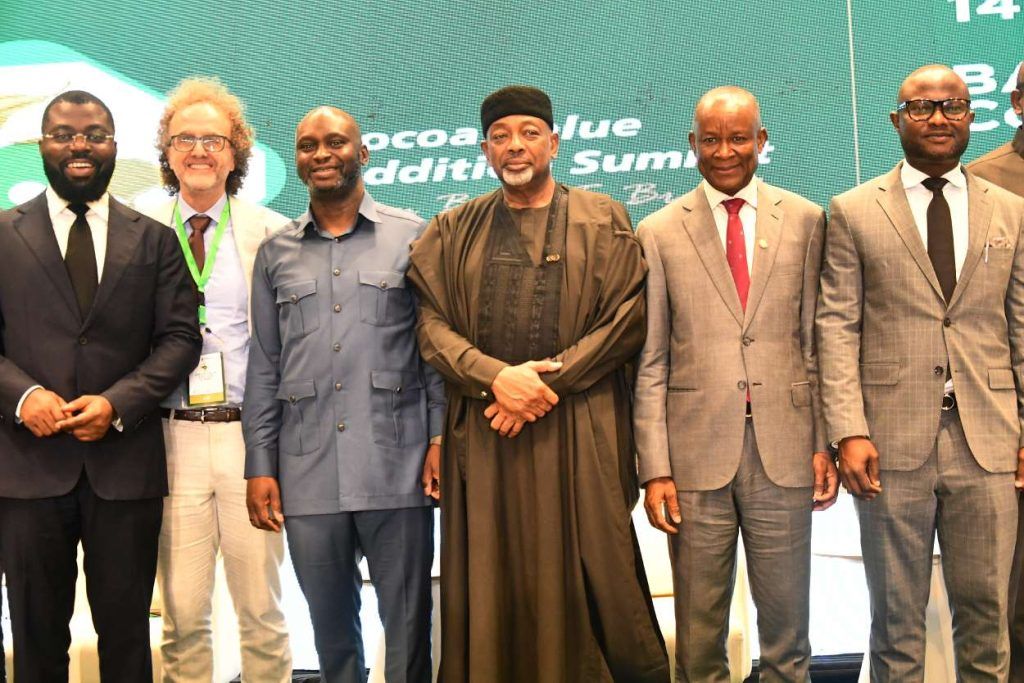
The Bank of Industry (BOI) has secured a €60 million credit facility from the European Investment Bank (EIB) to support Nigeria’s cocoa and dairy value chains, with a strong focus on local processing, ingredient production and chocolate manufacturing.
Managing Director and Chief Executive Officer of BOI, Dr Olasupo Olusi, disclosed this at the Africa Cocoa Summit, also known as the Cocoa Value Addition Summit, held in Abuja on July 14 and organised by the Federal Ministry of Industry, Trade and Investment.
The summit, themed “From Bean to Brand,” brought together government officials, industry leaders and stakeholders from Nigeria, Ghana, Côte d’Ivoire and Cameroon. The participating countries signed the Abuja Declaration, establishing the Cocoa Value Addition Alliance (CVAA) aimed at deepening regional cooperation and promoting local cocoa processing.
Olusi explained that the €60 million forms part of a broader €85 million EIB-BOI financing facility supported by the European Union under its Global Gateway initiative.
According to him, about 70 per cent of the €85 million facility will be directed towards Nigeria’s cocoa and dairy industries, sectors considered critical for job creation, industrialisation and foreign exchange retention.
“This agreement reinforces the Bank of Industry’s commitment to unlocking long-term, affordable finance for priority sectors that drive inclusive growth,” Olusi said.
“Approximately 70 per cent of the €85 million financing facility will be channelled to Nigeria’s cocoa and dairy sectors, which BOI considers among the industries with the greatest potential to create jobs and retain foreign exchange earnings.”
He noted that BOI would prioritise financing for processors, cooperatives and micro, small and medium-sized enterprises (MSMEs) engaged in local value addition rather than businesses focused solely on exporting raw cocoa beans.
Olusi stressed that Nigeria must move away from dependence on raw commodity exports and develop processing capacity close to cocoa-producing communities to ensure that jobs, taxes and economic benefits remain within the country.
“The era of celebrating volumes of raw exports must end,” he said, adding that Nigeria loses significant value by exporting cocoa beans and importing finished chocolate products.
Beyond financing, the BOI chief said the bank would provide technical assistance to beneficiaries, helping them meet international compliance requirements, climate-related standards and access opportunities in the European market.
He added that BOI would support farmers and processors in complying with the European Union Deforestation Regulation and other environmental and social standards required for international trade.
Highlighting the bank’s recent interventions, Olusi said BOI disbursed more than ₦164 billion to over 3,500 agro-processing and food manufacturing businesses in 2025. The funding supported factories, mills, packhouses and cold-chain infrastructure while integrating nearly 48,000 smallholder farmers into industrial value chains.
He noted that the new financing package would support the entire cocoa ecosystem, including nurseries, farmer cooperatives, grinding plants, ingredient manufacturers, packaging facilities and chocolate producers.
Speaking at the summit, President Bola Tinubu called on African cocoa-producing countries to reduce their reliance on exporting raw cocoa beans and focus on value addition to capture a greater share of the global chocolate market.
Represented by the Minister of Agriculture and Food Security, Senator Abubakar Kyari, the President noted that Africa produces about 70 per cent of the world’s cocoa but receives only a small fraction of the wealth generated by the global chocolate industry.
Tinubu reaffirmed Nigeria’s commitment to expanding local cocoa processing, increasing chocolate production, developing indigenous brands and strengthening the country’s competitiveness in international markets.
He said cocoa value addition remains a key pillar of the Renewed Hope Agenda and Nigeria’s industrialisation strategy.
The President also disclosed that investors are developing a 70,000-tonne cocoa processing facility in Shagamu, Ogun State, while the country’s cocoa grinding capacity has exceeded 120,000 tonnes annually.
Minister of Industry, Trade and Investment, Dr Jumoke Oduwole, described the summit as part of efforts to build a $1 trillion Nigerian economy by 2030.
She observed that despite Nigeria’s significant role in global cocoa production, the country captures only a small portion of the value generated across the industry.
According to her, the Federal Government is promoting greater value addition through manufacturing incentives, investment promotion and stronger collaboration among stakeholders.
She added that efforts were also underway to improve market access through existing trade partnerships and opportunities offered by the African Continental Free Trade Area (AfCFTA).
Minister of State for Industry, Senator John Owan Enoh, announced plans for the Cocoa Value Addition Alliance involving Nigeria, Ghana, Côte d’Ivoire and Cameroon, countries responsible for roughly 75 per cent of global cocoa production.
He said the alliance would strengthen regional cooperation, encourage local processing and help producing countries secure a larger share of global cocoa revenues.
“We are not here to disrupt existing partnerships but to expand them,” Enoh said, urging African nations to move beyond exporting raw beans and focus on developing globally competitive cocoa brands.
Also speaking, Chief Executive of the Ghana Cocoa Board (COCOBOD), Dr Ransford Abbey, called for increased domestic processing across Africa’s cocoa-producing nations.
“Africa produces about 75 per cent of the world’s cocoa but earns less than 10 per cent of the global chocolate industry’s wealth,” Abbey said.
“This system cannot continue. We must shift the paradigm from exporting raw poverty to creating refined wealth right here on the African continent.”
He emphasised that stronger regional collaboration, technology transfer and investment would be critical to achieving that objective.
The Head of Cooperation of the European Union Delegation to Nigeria and ECOWAS, Mr Massimo De Luca, reaffirmed the EU’s support for the initiative and stressed the importance of value addition across the cocoa value chain.
He urged participating governments to establish the policy and regulatory frameworks necessary to ensure the success of the alliance and maximise the benefits of local cocoa processing.