

Nigeria’s digital media landscape is undergoing a significant transformation, with total online readership traffic declining by 26.2 per cent in 2025, according to the SquirrelPR RANKED 2026 Report.
The report shows that aggregate visits to Nigerian digital publishing platforms fell from over 1.04 billion in 2024 to 769 million in 2025, underscoring what analysts describe as a structural shift rather than a decline in audience engagement.
At the heart of the disruption is the increasing adoption of artificial intelligence in information discovery. AI-powered search engines now deliver direct responses to user queries, often eliminating the need for users to click through to original news websites, even though those platforms remain the primary sources of the content.
Jonah Solomon, Co-founder of SquirrelPR, said the development marks the erosion of a long-standing digital media model built around page views and clicks.
“The industry is moving beyond traffic as the dominant currency,” he said. “Authority, credibility, and the ability to influence conversations are becoming far more important in defining media relevance.”
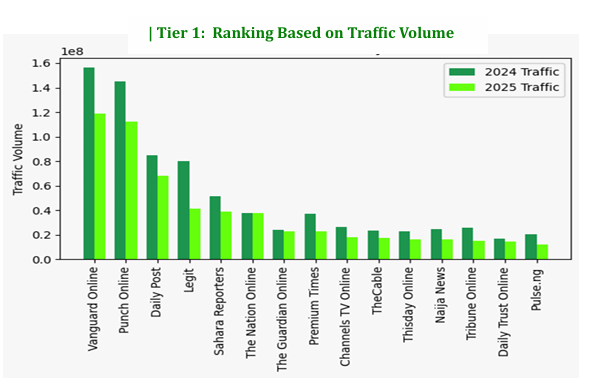
Chat showing Nigeria’s ranking by traffic
Delivering a keynote at the report’s unveiling, Keni Akintoye, CEO of KT Communication, said the shift represents a deeper evolution in how content is consumed and valued.
“Consumption has not declined; it has simply changed form,” Akintoye noted. “Audiences are engaging with information differently, often without visiting the source directly. That makes trust a more critical metric than traffic.”
The report identifies credibility and domain authority as emerging benchmarks for visibility, particularly in an ecosystem increasingly shaped by AI-driven content aggregation and summarisation.
It further reveals uneven impacts across different segments of the media industry. Established news organisations continue to play a central role in supplying verified information that powers both search engines and AI systems. Meanwhile, niche business publications are gaining ground by offering specialised insights to targeted audiences.
Technology-focused platforms are experiencing the most disruption, as their content is more susceptible to AI summarisation. On the other hand, entertainment and lifestyle media have shown relative resilience, benefiting from content formats that rely heavily on culture, personality, and audience interaction.
Stakeholders at a panel discussion during the launch emphasised the need for a strategic shift across the industry. Múyiwa Mátuluko, CEO of Businessfront, called for a stronger focus on in-depth, high-quality reporting. Rasheed Bolarinwa of Polaris Bank said advertisers are now prioritising engagement quality and trust over sheer audience numbers.
From the newsroom perspective, Olufemi Ajasa, Online Editor at Vanguard, stressed that credible journalism remains the foundation of influence. Damilola Bright-Ukwenga highlighted the growing role of digital creators and micro-influencers in shaping public discourse, while Ifeanyi Abraham of CIG Motors described the ongoing transition as profound and urged media players to adapt quickly.
The report concludes that the era of measuring success primarily through traffic metrics is fading, replaced by a more complex framework centred on trust, authority, and impact.
It also announced the introduction of SquirrelPR 2.0, an AI-powered public relations platform, alongside SMT Monitor, a tool designed for media monitoring and social listening.
Overall, the findings suggest that Nigeria’s digital media ecosystem is not in decline but evolving into a more sophisticated, AI-influenced environment where credibility and influence increasingly outweigh clicks and page views.