
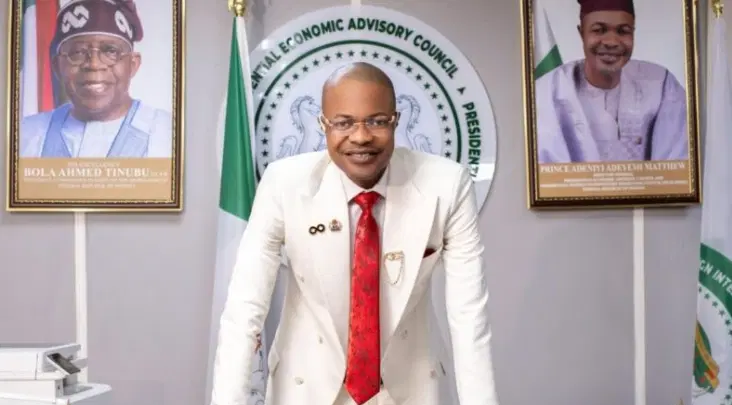
– His vote of confidence on Gbaja shows outcome, undermine the court case
The controversy surrounding the purported Presidential Foreign Intervention Promotion Council (PFIPC) has rapidly evolved from what initially appeared to be a straightforward case of forgery and impersonation into one of the most troubling governance scandals of the Bola Tinubu administration.
At the centre of the storm is Prince Adeniyi Adeyemi Matthew, a man the Presidency has described as an impostor, who forged documents, impersonated government officials, and operated a non-existent agency.
Yet, weeks after the scandal broke, questions continue to multiply rather than diminish.
For many observers, the real issue is no longer whether Adeyemi is a fraudster. Evidence from his past suggests he has a long history of questionable conduct, including allegations of forgery, impersonation and misrepresentation of his credentials.
Those controversies, coupled with recent investigations into his activities, have painted a picture of a man with a long record of alleged institutional fraud, document forgery and impersonation, leading many observers to argue that the current PFIPC controversy appears consistent with a pattern that has followed him for years.
Yet, for many, the central question has become how one individual allegedly succeeded in creating the appearance of a federal government agency complete with office space, government staff, budgetary allocations, official recognition, and access to high-ranking officials, including the Central Bank, without assistance from powerful insiders.
And perhaps, more importantly, whether the Tinubu administration is more interested in exposing the entire network behind the scandal, or merely sacrificing Adeyemi while shielding influential figures within government.
Presidency’s swift denial raises suspicion
The first signs that the scandal might become politically explosive emerged from the speed and manner of the Presidency’s response. Immediately after Adeyemi publicly accused Chief of Staff to the President, Femi Gbajabiamila, of demanding bribes in exchange for facilitating his appointment, the Presidency moved quickly to disown both him and the PFIPC.
In a disclaimer dated June 11, 2026, Gbajabiamila stated categorically that neither the office, nor the appointment existed.
“It has come to the notice of the Federal Government of Nigeria, and specifically the Office of the Chief of Staff to His Excellency, President Bola Ahmed Tinubu, that a certain Prince Adeniyi Adeyemi… is portraying himself to the general public as having been appointed by my office.
“The unsuspecting public is hereby advised to note that such an office does not exist under this administration and no appointment has been made in that regard.”
Ordinarily, such a disclaimer might have settled the matter. Instead, it deepened public suspicion. Critics argue that the Presidency appeared less interested in establishing the facts than in immediately distancing Gbajabiamila from the controversy.
The speed with which Adeyemi was labelled an impostor before any comprehensive investigation had been concluded fuelled perceptions that the administration had already decided where responsibility would ultimately rest. For opposition politicians, civil society groups, and legal analysts, the concern is that the government appears determined to isolate the scandal around one individual rather than investigate the broader network that allegedly enabled it.
Tinubu and the Gbajabiamila factor
Much of the controversy revolves around the political significance of Gbajabiamila within the Tinubu administration. As Chief of Staff, he is widely regarded as one of the most powerful figures in government, and one of Tinubu’s closest political allies.
This reality has led many critics to conclude that the Presidency cannot afford to sacrifice him regardless of what any investigation might uncover. The perception gained further traction when Federal Capital Territory Minister, Nyesom Wike, publicly dismissed calls for Gbajabiamila’s suspension, or removal.
“I know the Chief of Staff very, very well. He did not,” Wike declared during a media chat in Abuja. “People are saying the Chief of Staff must be sacked. By whom? The opposition? Why not form a government, and then you can sack whoever you want to sack.”
To critics, Wike’s intervention revealed what they see as the administration’s broader mindset: that protecting key political figures has become more important than ensuring transparency.
Actress and politician Hilda Dokubo echoed this concern. “You cannot be mentioned in a matter that involves a disputed presidential body, alleged budget entry, alleged money demands, alleged intimidation, and you sit in the same office as if nothing happened.
“That is not accountability, that’s arrogance and impunity. So, step aside and let the investigation breathe.”
Her argument reflects a common principle in many democracies – public officials facing serious allegations often temporarily step aside to avoid influencing investigations.
That possibility has never been seriously entertained by the Presidency. Instead, President Tinubu publicly expressed “100 per cent confidence” in his Chief of Staff even while ordering an investigation into the scandal. For critics, that declaration effectively signalled the likely outcome before investigators had even begun their work.
The mystery of the phantom agency
The biggest problem confronting the government’s narrative is the sheer scale of institutional involvement required to create what it now describes as a fictitious agency. According to available evidence, the PFIPC operated from an office within the Federal Secretariat in Abuja. It had government-assigned personnel. It maintained a website on the government’s official domain.
It reportedly secured approvals to recruit hundreds of workers despite a broader freeze on public sector recruitment. It opened a Central Bank of Nigeria account. Most significantly, it appeared in the 2026 Appropriation Act with a budget allocation of N1.3 billion.
These facts have made it difficult for many observers to accept the theory that Adeyemi acted entirely alone. Babachir Lawal, former Secretary to the Government of the Federation, dismissed such a possibility.
“There is no way in a normal system that the agency is fake and the government would not know. You cannot create a budget code for yourself without the budget office knowing. There must be connivance with officials within.”
Budget transparency advocate, Oluseun Onigbinde, reached a similar conclusion.
“The functional head of the agency cannot just do that alone, he told BBC. “It has to come from the State House.”
The observations strike at the heart of the scandal. Even if Adeyemi forged appointment letters, how did those documents pass through multiple layers of government scrutiny? How did a non-existent agency secure office space inside a federal complex? How did it obtain a budget code? How did it survive long enough to receive an allocation in the national budget? These questions remain unanswered.
A familiar pattern?
Former Vice President Atiku Abubakar believes the scandal fits into a broader pattern. According to him, efforts to shield Gbajabiamila have only deepened public suspicion.
“The tactics employed by the Presidency to rescue the Chief of Staff from the mounting allegations have exposed the Tinubu administration to even greater public ridicule and suspicion,” Atiku said.
He argued that the PFIPC controversy cannot be dismissed as an isolated incident. Instead, he linked it to longstanding concerns about questionable budget insertions and opaque spending practices.
His intervention resonated with critics, who believe the scandal exposes deeper structural weaknesses in Nigeria’s budgeting and oversight systems.
Adeyemi’s credibility problem
Yet, while questions persist about government accountability, Adeyemi himself carries significant credibility baggage.
Indeed, one reason the Presidency’s narrative has gained traction is his documented history of controversy. In 2023, while serving as a Senior Special Assistant on Sustainable Development Goals to Osun State Governor, Ademola Adeleke, Adeyemi was dismissed after allegedly forging government documents.
He was accused of forging Adeleke’s signature on letters sent to the French Embassy. The incident resulted in his immediate removal from office. That was not the first time his claims attracted scrutiny.
In 2016, Adeyemi presented himself as President-General of the World Youth Organisation and claimed to be a United Nations ambassador. The United Nations subsequently distanced itself from those claims and clarified that neither the organisation nor the title enjoyed official UN recognition.
Investigations into his activities exposed what critics described as a pattern of institutional impersonation and fraudulent representation. Against this backdrop, many observers see the PFIPC controversy as consistent with his past conduct.
“I think it’s obvious now that Adeyemi is a conman,” Anthony Chidi, a lawyer and political affairs analyst, told Business Hallmark. “But there’s no way he could have succeeded to the point that he did without working with people in government. So, it is not enough for the government to pretend as if he is the only villain.
“But that’s what we’re seeing, apparently because they want to protect powerful people, who might be involved.”
Does Adeyemi’s latest admission clear Gbajabiamila?
A major twist emerged when Adeyemi appeared to retreat from some of his earlier allegations. In an interview with social media influencer, Martins Otse, popularly known as VeryDarkMan, Adeyemi admitted he had never physically met Gbajabiamila.
He also said he was unsure of the Chief of Staff’s exact role in his purported appointment.
“I would not say he is lying and I won’t say he is saying the truth,” Adeyemi said. “I think three times I have spoken with Gbajabiamila through my late friend, Dolapo Tanimola.”
The admission significantly weakened claims of direct dealings between the two men. But Tanimola’s alleged sudden death has since raised questions.
Indeed, Gbajabiamila’s lawyers insist the pair have never met and have threatened a N10 billion defamation suit.
Yet, analysts caution against treating the revelation as automatic exoneration. Political influence in Nigeria often operates through networks of intermediaries rather than direct interaction.
Senior public officials frequently rely on associates, aides, consultants and political loyalists to conduct sensitive transactions. Consequently, critics argue that the absence of direct contact does not necessarily eliminate the possibility of indirect involvement.
At the same time, it does weaken claims that Gbajabiamila personally negotiated, or supervised the alleged transactions. Complicating matters further is evidence that Gbajabiamila had reportedly petitioned authorities regarding Adeyemi’s activities, which led to his arrest last year, long before the scandal became public.
For some, that fact would strengthen arguments that the Chief of Staff may have been a victim, rather than a participant.
Why critics reject the lone-wolf theory
For many observers, the biggest flaw in the government’s position is the insistence that Adeyemi acted largely alone. Constitutional lawyer, Festus Ogun, believes that explanation simply does not withstand scrutiny.
“The Presidency has further indicted itself,” Ogun argued. “For one single person to allegedly operate a council with the purported authorisation of the Presidency, got an office complex within the Federal Secretariat, got the necessary approvals, had over N1.3 billion in the Nigerian budget, got a budget code, got accounts opened with the CBNi, and you are telling us that it is fictitious? I don’t think so.”
He noted that the agency reportedly had staff posted from government institutions and operated openly for months.
“Whether the Presidency likes it or not, some people in there ought to be investigated alongside the main man.”
For Ogun and others, the scandal raises uncomfortable questions about whether Nigeria’s bureaucracy is vulnerable to manipulation, or whether insiders actively facilitated the operation. Either possibility points to serious governance failures.
Independent probe, court, or internal investigation?
President Tinubu has directed the ICPC to investigate the scandal and submit its findings within 30 days. The probe is expected to examine forged documents, financial transactions, and the role of public officials who may have assisted the scheme. Meanwhile, Adeyemi has sued the government to court.
While the directive has been welcomed by some, critics remain unconvinced. They argue that an internal investigation lacks the independence required for a matter involving senior officials within the Presidency. This explains growing calls for a judicial commission of inquiry.
Adeyemi himself has demanded an independent panel, insisting he possesses documents capable of proving his claims. His lawyer, human rights advocate, Femi Falana, SAN, has similarly argued that the investigation should not focus exclusively on his client.
“This guy should not just be sacrificed alone,” Falana reportedly said. “Those who used him to achieve their own objectives will have to be exposed.” The whole process, many believe has become a cover up.
More questions than answers
Ultimately, the PFIPC saga has become a test of the Tinubu administration’s commitment to transparency and accountability. There is little doubt that Adeyemi’s history undermines his credibility.
His record of disputed claims, alleged forgery and institutional impersonation makes him a deeply problematic witness. Yet his credibility problems do not automatically validate the government’s account.
The unanswered questions remain substantial. How did a supposedly fake agency obtain office space, staff and official recognition? How did it find its way into the national budget? Who approved its operations? Who looked the other way?
And why did the Presidency appear more eager to dismiss the allegations than to publicly interrogate the processes that enabled them? Until those questions are convincingly answered, suspicions of a cover-up are unlikely to disappear.