
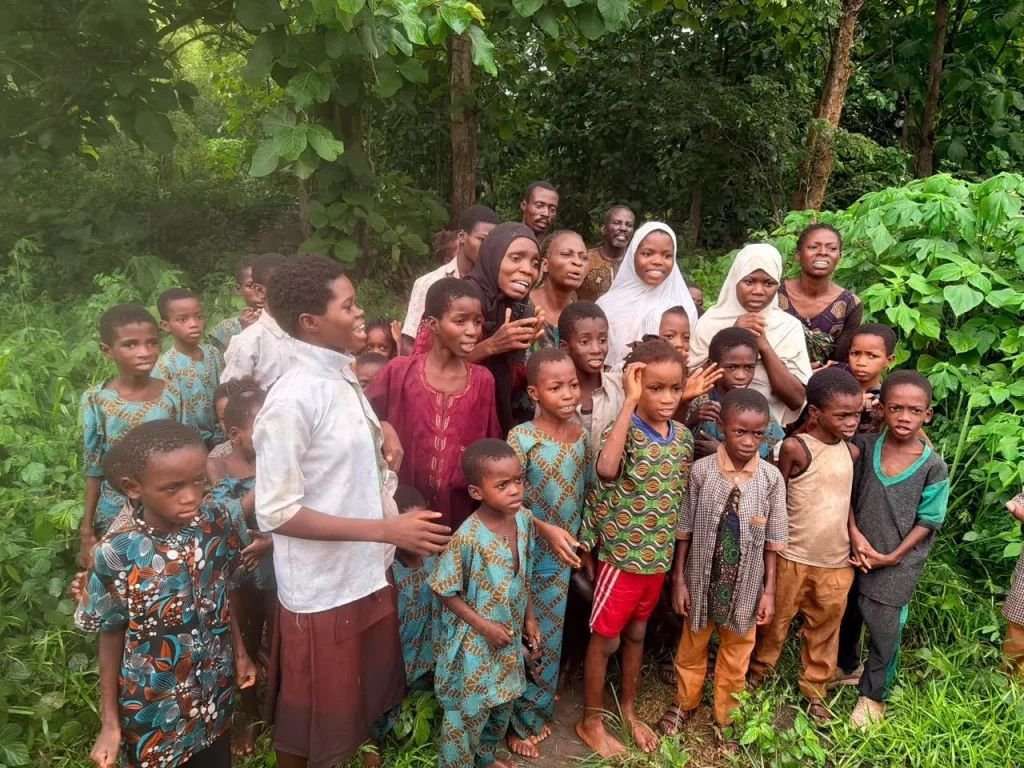
After 56 days in captivity, all the pupils and teachers abducted from schools in Oriire Local Government Area of Oyo State have regained their freedom, bringing an end to one of the country’s most disturbing mass kidnapping incidents in recent times.
The Special Adviser to President Bola Tinubu on Information and Strategy, Bayo Onanuga, announced the development on Friday, confirming that security agencies successfully rescued all the victims.
“Finally, all the kidnapped pupils and teachers in Orire, Oyo have been rescued by our security agencies,” Onanuga wrote on his X account.
He later disclosed that eight suspected kidnappers were arrested during the operation and are currently being held by the Department of State Services (DSS), while several others were killed.
Onanuga also dismissed speculation that the victims were freed through a prisoner exchange, insisting that no concessions were made to the abductors.
According to him, one of the terrorist leaders whose release had reportedly been demanded by the kidnappers remains on trial for terrorism-related offences.
The rescue brings to a close a tense and emotional episode that began on May 15 when heavily armed gunmen attacked three schools in the Ahoro-Esiele and Yawota communities near Ogbomoso.
Witnesses said dozens of attackers, some dressed in military-style uniforms and riding motorcycles, stormed Community Grammar School, Baptist Nursery and Primary School, and L.A. Primary School, shooting indiscriminately before carting away pupils, students and teachers.
At least one person was killed during the attack.
Governor Seyi Makinde later confirmed that 46 people were abducted, including 39 pupils and seven teachers. Among those taken were the principal of Baptist Nursery and Primary School, Folawe Alamu, and a two-year-old child.
The attack triggered national outrage and prompted immediate responses from both the federal and state governments.
President Bola Tinubu condemned the abduction, describing it as barbaric, and directed security agencies to launch an intensive operation to secure the release of the victims.
The Inspector-General of Police, Kayode Egbetokun, subsequently deployed additional personnel and investigative resources to Oyo State as part of a technology-driven rescue effort.
Public anger deepened weeks later after reports emerged that one of the abducted teachers, mathematics instructor Michael Oyedokun, had been killed by the kidnappers.
A video allegedly showing his beheading circulated online, sparking widespread condemnation and increasing pressure on authorities to rescue the remaining captives.
The Federal Government responded by sending a high-powered delegation led by Chief of Staff to the President, Femi Gbajabiamila, to visit affected communities.
The delegation included National Security Adviser Nuhu Ribadu, Chief of Defence Staff Gen. Christopher Musa and other senior officials.
President Tinubu also approved the recruitment of 1,000 forest guards for Oyo State as part of efforts to strengthen security in vulnerable communities.
As the crisis dragged on, reports surfaced that the abductors had established communication with authorities and demanded the release of detained terror suspects as a condition for freeing the victims.
The prolonged captivity triggered industrial action by the Nigeria Union of Teachers (NUT), which directed public school teachers across Oyo State to embark on an indefinite strike from June 1.
The union insisted that schools could not safely operate while the victims remained in captivity.
The strike, which disrupted academic activities across the state, was eventually suspended in early July after government assurances that efforts to secure the hostages were yielding results.
Throughout the period, rumours and false reports repeatedly claimed that the victims had been released, prompting multiple denials from both the Oyo State Government and security agencies.
Civil society organisations, parents and community leaders also mounted pressure on authorities, while social media campaigns kept public attention focused on the plight of the captives.
Earlier this week, Defence Minister Mohammed Badaru Abubakar disclosed that security agencies had exercised restraint because the kidnappers threatened to kill the hostages if a direct military assault was launched against their hideouts.
The minister said the situation required a careful strategy that balanced security operations with efforts to preserve the lives of the captives.
With Friday’s announcement, the ordeal has finally come to an end, although many questions remain regarding the details of the rescue operation and the condition of the victims after nearly two months in captivity.
Security agencies are expected to provide further information on how the operation was conducted, the identities of those arrested and the next steps in the prosecution of the suspects.
For families who endured weeks of uncertainty and anguish, however, the successful rescue represents a moment of relief and a long-awaited end to a traumatic chapter that captured national attention.