
– Abridged timelines landmine for INEC
What began as a routine clause-by-clause consideration of the 2025 Electoral Act Amendment Bill in the Senate last Wednesday quickly degenerated into confusion, confrontation, and ultimately, a national controversy that now threatens to cast a long shadow over preparations for the 2027 general elections.
At the heart of the storm is electronic transmission of results, the single phrase that defined the dispute and distrust surrounding the 2023 presidential election. For many Nigerians, that phrase is the difference between transparency and suspicion.
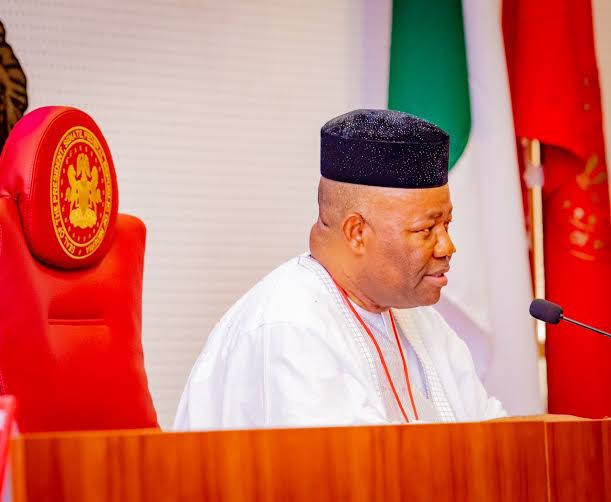
And last Wednesday, when Senate President, Godswill Akpabio, announced during plenary that Clause 60 had been adopted “as amended and not as recommended,” many observers, journalists and civil society actors interpreted it to mean that the Senate had rejected the proposal to make real-time electronic transmission of results to INEC’s Result Viewing Portal (IReV) mandatory.
The reaction was immediate and fierce.
But what has followed since is a deepening division within the Senate itself, with several senators accusing Akpabio of misrepresenting what the chamber agreed, while civil society groups, opposition parties and political leaders warn that the amendment, as it stands, may have quietly reopened the very loopholes that triggered the legitimacy crisis of 2023.
Meanwhile, the Senate has convened an emergency plenary for Tuesday, in response to the mounting pressure.
A Plenary off Script
Tension had already built earlier in the session when Senator Ali Ndume and Senator Abdul Ningi confronted Akpabio over the composition of the harmonization committee. The two lawmakers openly questioned why Senator Simon Lalong, who chaired the Electoral Act Amendment Committee and presided over the entire legislative process, had been dropped from the harmonization committee.
Ndume pointedly asked: What exactly is the committee harmonizing without the chairman, who led the process? Akpabio quickly announced that Lalong was now included. But in a dramatic twist, Lalong, visibly angered, said he was withdrawing and did not want to be part of the committee anymore.
That exchange would later be viewed by some observers as an early sign that something was amiss in how the final provisions of the bill were being handled. Moments later came Akpabio’s declaration on Clause 60:3 – the clause dealing with the transmission of results – and the confusion that has since engulfed the country.
Why Clause 60 Matters
The controversy over electronic transmission did not begin this week. It is rooted in the events of February 25, 2023. On election day, INEC had repeatedly assured Nigerians that polling unit results would be uploaded to IReV in real time. When that did not happen for the presidential election, blamed on “technical glitch,” suspicion exploded across the country.
While results from National Assembly elections appeared on the portal, the presidential results did not. For many Nigerians, that moment marked the beginning of a crisis of confidence in the electoral process. Although the Supreme Court later upheld the outcome of the election, the court was emphatic on the point that electronic transmission was not expressly provided for in the Electoral Act 2022. INEC’s guidelines, the court ruled, could not override the law.
That judicial pronouncement set off a national consensus that the law must be amended to explicitly provide for electronic transmission, rather than the transfer of results. Civil society groups, political parties, and electoral experts all agreed that this was the single most important reform needed before 2027.
Akpabio Accused of Mischief
That is why several senators have now come forward to say the public may have been misled by what happened in plenary. Led by Senator Enyinnaya Abaribe, 13 senators addressed journalists in Abuja to insist that the Senate did not reject electronic transmission.
According to Abaribe, the confusion arose from the difference between the words “transfer” and “transmit.” “What is in the 2022 Electoral Act is ‘transfer.’ What we agreed on is ‘transmission,’” he said. “We do not want a vague law that can be misinterpreted.”
He and others, including Senators Abdul Ningi and Victor Umeh, said more than two-thirds of senators supported electronic transmission during consultations, retreats, and public hearings.
Umeh would later reveal on national television that over 85 percent of senators backed electronic transmission, and that no debate took place in plenary to remove it. He explained that the only concern raised was about the phrase “in real time,” which some senators feared could create legal complications if technical delays occurred.
But outside the Senate, that distinction is not reassuring many Nigerians. For election observers, lawyers, and civic groups, removing “real time” is not a minor semantic adjustment. It could become the exact loophole through which delays, manipulations, and post-poll alterations can creep back into the system.
Itodo: “A dangerous retreat”
Samson Itodo, Executive Director of Yiaga Africa and a member of the technical committee that worked on the amendment, did not mince words. “What the senators did is a betrayal of trust,” he said.
According to him, the House of Representatives had clearly inserted provisions for electronic transmission to IReV, following the Supreme Court’s guidance. But the Senate’s version, he warned, weakens that safeguard.
He also raised another alarm about logistics, which has received less attention, but could prove just as consequential for 2027. The amendment, as passed, reduces the notice of election from 360 days to 180 days. It also cuts the timeline for publishing the list of candidates from 150 days to 60 days before the election.
“These compressed timelines will increase the risk of logistics problems,” Itodo warned. “When is INEC going to print ballot papers? When is it going to prepare?” For an election body already stretched by Nigeria’s scale and complexity, this compression, he said, could create avoidable chaos.
Opposition sees a pattern
Opposition parties have interpreted the Senate’s action as deliberate. In their statements the PDP, ADC, and Labour Party accused the ruling APC-controlled Senate of seeking to preserve vulnerabilities in the system ahead of 2027.
They noted the irony that political parties use technology for internal primaries, but resist similar transparency in national elections. “The Senate has returned Nigeria to square one,” the parties said.
They are now urging the conference committee to adopt the House of Representatives’ clearer position on mandatory real-time transmission.
Atiku: “A Betrayal of Democracy”
Former Vice President, Atiku Abubakar, condemned the Senate for rejecting e-transmission of election results, branding it “a betrayal of democracy.”
Atiku, who reacted on Thursday, on X, described the rejection by the lawmakers as “a deliberate assault on electoral transparency,” noting that the “ill-advised action represents a grave setback for electoral reform and a calculated blow against transparency, credibility, and public trust in Nigeria’s democratic process.”
Obi: “An Unforgivable Act”
Former LP presidential candidate, Peter Obi, described the development as “an unforgivable act of electoral manipulation ahead of 2027.” He linked the controversy directly to the experience of 2023, saying the refusal to fully implement electronic transmission was what triggered disputes and distrust. “While African nations are embracing technology, Nigeria is moving backwards,” Obi said.
Growing Calls for Resistance
Public affairs commentator, Charles Ogbu, went further, suggesting that participating in elections without mandatory electronic transmission would be pointless.
Across social media and civic spaces, conversations have shifted from legal interpretation to political intent. Was this simply poor legislative communication? Or, as some senators now suggest, was there mischief in how the provision was announced and framed?
Logistics Time Bomb
Under the Electoral Act 2022, INEC is required to issue notice of election 360 days before polling. This long window is not ceremonial. It allows the commission to plan procurement, deploy technology, train staff, print ballot papers, accredit observers, and coordinate security logistics across 176,000 polling units nationwide. The new Senate amendment cuts that window in half, to 180 days.
It also reduces the timeline for publishing the final list of candidates from 150 days to 60 days before the election. To the average observer, these may appear like routine administrative adjustments. But to election managers, they are red flags.
Itodo warned that these compressed timelines could “set INEC up for failure.” According to him, “When do you print ballot papers? When do you distribute sensitive materials? When do you train ad hoc staff?”
Nigeria’s elections are among the most complex in the world. Ballot papers are printed abroad under tight security timelines. Names of candidates must be finalized months ahead to avoid legal disputes and reprints. Logistics require coordination with security agencies, transporters, and state offices across difficult terrains.
A Familiar Pattern from 2023
Observers note that many of the operational problems INEC cited in 2023, delays, technological strain, last-minute adjustments, were linked to time pressure and logistics coordination. That is why, for reform advocates, the 360-day notice was seen as a deliberate safeguard.
By reducing it, critics say, the Senate may have inadvertently recreated the very conditions that contributed to the challenges of the last general election. And when combined with ambiguity over electronic transmission, the fear is that both the processes before and after voting are now exposed to avoidable vulnerabilities.
Pressure from Outside the Senate
The Obidient Movement has already announced plans to mobilize Nigerians for a peaceful march to the National Assembly. Opposition parties are urging the conference committee to reject the Senate’s position.
Public figures like Charles Ogbu have called for mass civic resistance, arguing that elections without guaranteed electronic transmission would be meaningless